Reserve running up the gullies between the streets puts a lot of Lane Cove arrays directly under gum canopy rather than open sky. Leaf and bark land on the glass constantly, sap and honeydew drip from overhead, and both need dissolving rather than rinsing.
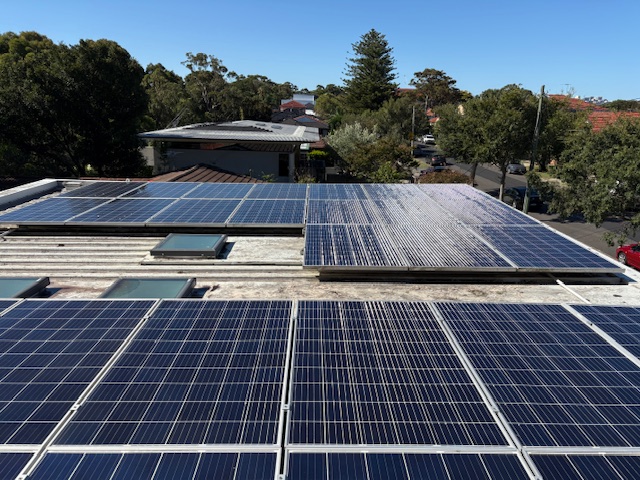
Lane Cove arrays sit closer to bushland than most, and that determines what lands on them.
With reserve pushing up the gullies between the streets and the national park wrapping the river edge, turpentine, blue gum and angophora canopy frequently sits directly above these roofs. Leaf, bark and seed drop year round rather than seasonally, and because the material is light it wedges along the lower frame of each row instead of blowing clear. Trapped there it holds moisture against the glass and the panel seal, and leaches tannin that dries as a bonded film.
Sap and honeydew are the second problem and the more stubborn one. Dripping from directly overhead, they land as sticky spotting that has to be dissolved rather than wiped, and they hold everything that lands afterwards.
Shading is a genuine consideration on blocks that fall into the gullies, where canopy on the western side cuts afternoon generation.
Around the village, arrays on the walk-up blocks sit on low-pitch roofs with plant and aerials, and access runs over common property where ladder work is restricted.
We clean with purified water and a soft brush, no detergent, and clear the debris collected along and beneath the frames.
The standard advice on solar cleaning assumes an open roof, and applying that interval beside bushland is how systems here end up chronically underperforming.
An array under gum canopy accumulates leaf, bark, sap and pollen continuously, so one cleaned on a generic annual schedule spends most of the year carrying material an open-sky suburb would never see. Matching the interval to the actual conditions is the whole fix, and it is a cheaper one than most owners expect.
Sap and honeydew are the specific reason a hose does not work. They are sticky and organic, so rinsing spreads them and any detergent residue attracts the next round within days. They have to be dissolved and rinsed clear, which is what purified water and proper dwell time do.
The debris along the lower frame costs more output than its area suggests, because a band of shading across the bottom of a row constrains the whole series string behind it.
For a strata building with a shared system, that lost generation is spread across every lot owner, which usually makes the cleaning cost trivial by comparison.
How we clean arrays with purified water and no detergent, and why output recovers once the glass is clear.
Proudly serving Sydney with expert exterior cleaning.
MONDAY: 7:30 AM — 6:00 PM
TUESDAY: 7:30 AM — 6:00 PM
WEDNESDAY: 7:30 AM — 6:00 PM
THURSDAY: 7:30 AM — 6:00 PM
FRIDAY: 7:30 AM — 6:00 PM
SATURDAY: CLOSED
SUNDAY: CLOSED