Lane Cove walls are shaded by bushland rather than by street trees, and reserve growing right up to a boundary keeps an elevation damp in a way a garden never does. On the walk-up blocks near the village the same damp shows up as streaking beneath every balcony instead.
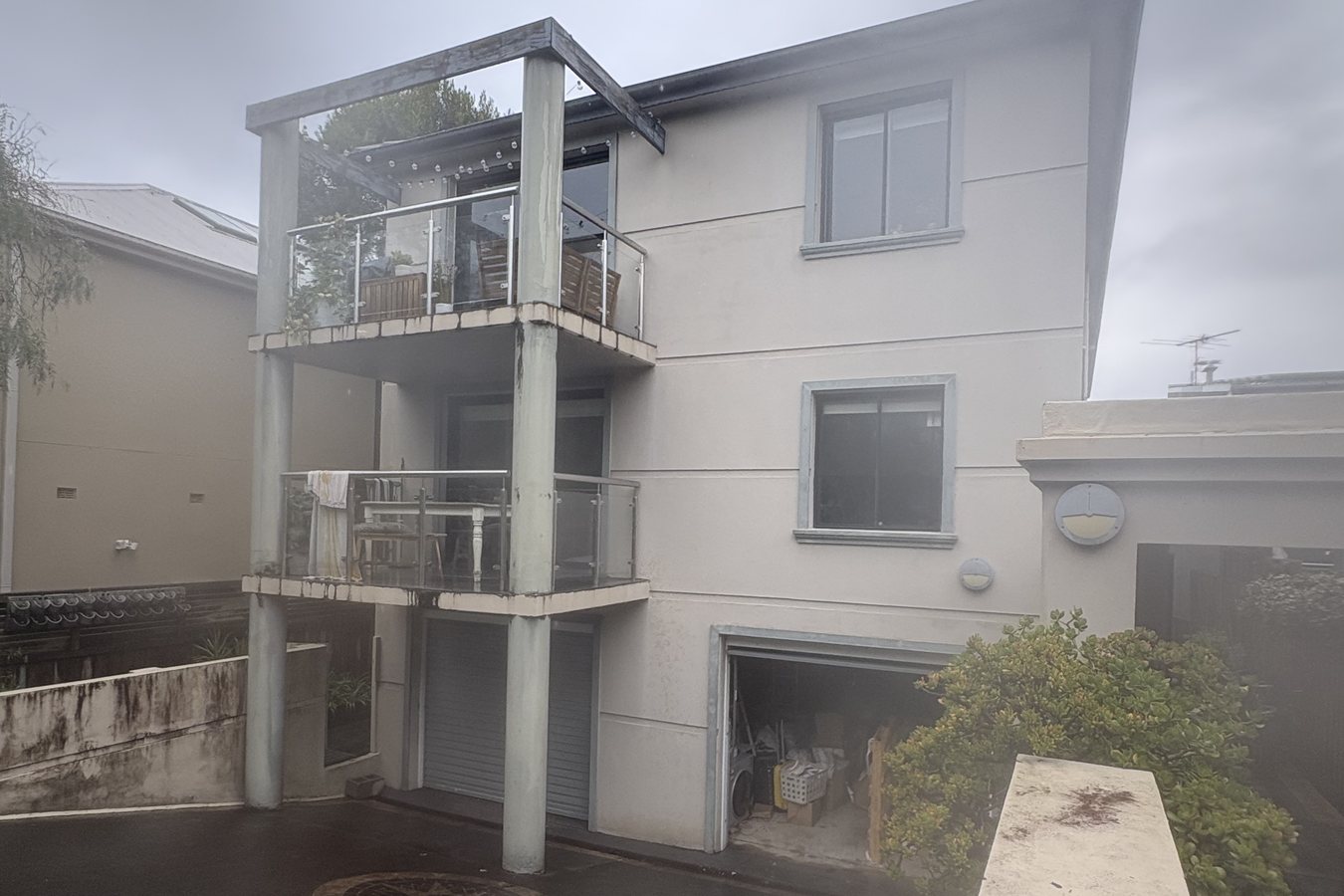
Reserve on the boundary is what sets wall conditions in Lane Cove.
Bushland runs up the gullies between the streets and wraps the suburb along the river, so a great many properties have unmanaged canopy immediately behind them rather than a garden that can be cut back. Those rear elevations sit in shade and still air, hold moisture from one rain event to the next, and grow a green-black film that starts low and works upward. Because the land falls toward the river, the worst-affected wall is usually the one at the bottom of the block that nobody walks past.
Around the village the stock changes to 1960s and 1970s walk-ups and newer apartments, and there the pattern is balcony soffits and the undersides of concrete slab edges. Those sit out of the rain, stay damp and streak down the wall below with every shower.
The substrates are mixed: face brick and rendered brick on the houses, painted render on the blocks, and fibro or weatherboard on older cottages and rear additions.
None of it takes pressure well, so we use a biodegradable solution at low pressure with dwell time, then rinse gently and wash down adjacent planting.
The value here divides along the same line the suburb does, but the underlying mechanism is the same on both sides.
For a house backing onto reserve, the benefit is that you stop repainting one elevation at a time. The rear wall in permanent bushland shade degrades years ahead of the street frontage, because mould holding moisture against a coating breaks it down from behind rather than through weathering. Washing on a schedule keeps the whole property on one longer repaint cycle.
For a walk-up block, the argument is presentation with a maintenance case behind it. Streaked balcony soffits read as neglect regardless of how the building is run, and that impression attaches to every lot. Underneath, a coating carrying mould fails early, and repainting a whole block is a special-levy expense where washing it is an operating one.
On the older fibro and weatherboard sections the stakes rise, since timber that stays wet behind failing paint rots rather than simply looking tired.
Killing growth at the root rather than stripping the visible layer is what makes the result last through the following winter.
Why low pressure is the right method for render, painted brick and weatherboard, and what the process involves.
Proudly serving Sydney with expert exterior cleaning.
MONDAY: 7:30 AM — 6:00 PM
TUESDAY: 7:30 AM — 6:00 PM
WEDNESDAY: 7:30 AM — 6:00 PM
THURSDAY: 7:30 AM — 6:00 PM
FRIDAY: 7:30 AM — 6:00 PM
SATURDAY: CLOSED
SUNDAY: CLOSED