Solar panels in Drummoyne pick up two quite different kinds of grime, depending on where the house stands on the peninsula. Along the Victoria Road corridor it is fine traffic soot; on the waterfront edges of the peninsula it is salt blown in off Iron Cove and Five Dock Bay. Both form a thin, even film that dims the glass, so the array looks fine from the footpath while its output quietly falls. Purified water clears either one without leaving residue behind.
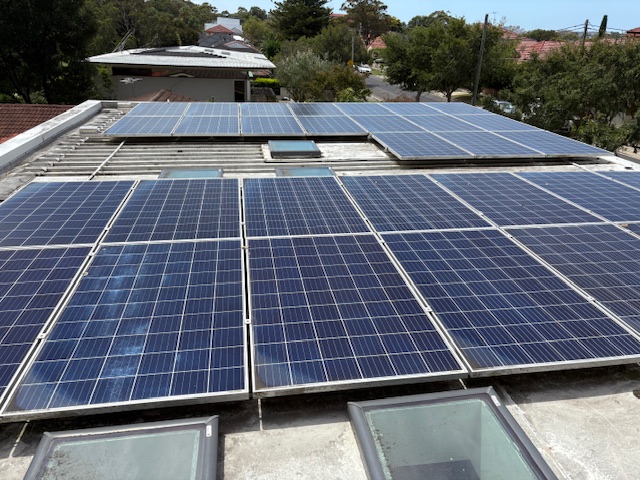
Traffic is the first factor. Documentation for the Iron Cove Link forecast 89,900 vehicles on an average weekday through Drummoyne and over Gladesville Bridge in 2023, rising to 98,500 by 2033. That volume sheds a fine, slightly oily soot which bonds to glass rather than blowing away. Rain tends to move it rather than remove it, and it can dry in streaks along the lower edge of each panel.
The foreshore brings the second. The peninsula has the Parramatta River on three sides, and council's planning for the oval precinct on Five Dock Bay records that it has no landform shelter from salt-laden winds. Salt settles on panels as a pale haze that turns tacky on humid nights, and that tacky surface then catches dust and pollen.
Trees and birds complete the picture. Brush box is the common street tree, and the Moreton Bay figs and camphor laurels on Bayswater Street beside Drummoyne Oval bear fruit that draws birds, whose droppings land in dense spots. A dropping that covers part of a cell costs more than its size suggests, because cells are connected in series and one heavily shaded cell can drag down the output of the cells around it. We clean with purified water and no detergent, so the panels dry spot-free and the glass and coatings are protected.
An array is a long-term purchase, and what it returns depends on how much light reaches the cells year after year. A soot or salt film cuts that light without showing any fault, so the most useful thing a clean does is put the system back in the conditions it was designed to work in.
How the panels are cleaned matters as much as the result. Tap water leaves mineral spots as it dries, and detergent can leave a residue that the next layer of traffic film clings to. Purified water carries nothing to leave behind, so the glass dries clear and its coatings are not exposed to chemicals they were never meant to meet.
If your owners corporation runs an array on a common roof, its output is a saving shared by every lot, and a documented clean with before-and-after photos is easy to justify at a committee meeting. For a house, the same photos show you what came off panels you cannot see from the ground.
There is also the question of who goes up. Roof work on a two-storey house or a flat building is not a job for a domestic ladder, and our team is certified to work safely at heights and covered by $10 million public liability insurance.
Yes. Exhaust and brake dust from a corridor carrying tens of thousands of vehicles a day settle as a fine, oily soot, and on glass it sticks instead of blowing off. Because it builds evenly there is often nothing obvious to see from the ground, which is why before-and-after photos from a clean can surprise owners.
Purified water has had its dissolved minerals removed, so it evaporates without spotting and leaves the glass bare. That suits Drummoyne, where salt and soot both settle on panels and anything left behind gives them something to cling to. It also keeps cleaning chemicals off the glass and its coatings altogether.
Only partly. Rain dissolves some of the salt, but as the panel dries the rest is left behind along with whatever dust the wind has carried in, and low-pitched arrays shed very little of it. On the exposed parts of the peninsula facing Iron Cove and Five Dock Bay, the film rebuilds between showers.
Droppings are one of the more costly kinds of soiling, because they block part of a cell completely rather than dimming it evenly. Fruiting trees draw birds, and the Moreton Bay figs and camphor laurels on Bayswater Street by Drummoyne Oval are a local example. Purified water softens and rinses droppings off along with the dust, pollen and salt film.
How we clean arrays with purified water and no detergent, and why output recovers once the glass is clear.
Proudly serving Sydney with expert exterior cleaning.
MONDAY: 7:30 AM — 6:00 PM
TUESDAY: 7:30 AM — 6:00 PM
WEDNESDAY: 7:30 AM — 6:00 PM
THURSDAY: 7:30 AM — 6:00 PM
FRIDAY: 7:30 AM — 6:00 PM
SATURDAY: CLOSED
SUNDAY: CLOSED