Drummoyne's Federation heritage houses were roofed in unglazed terracotta tile or slate, and examples survive on streets such as Lyons Road, Wolseley Street and St Georges Crescent. Unglazed tile has no glaze to shed water, so moss and lichen key into the clay itself, and salt carried on the wind off the bays helps keep it damp. Roof cleaning here begins with working out what each roof can safely take.
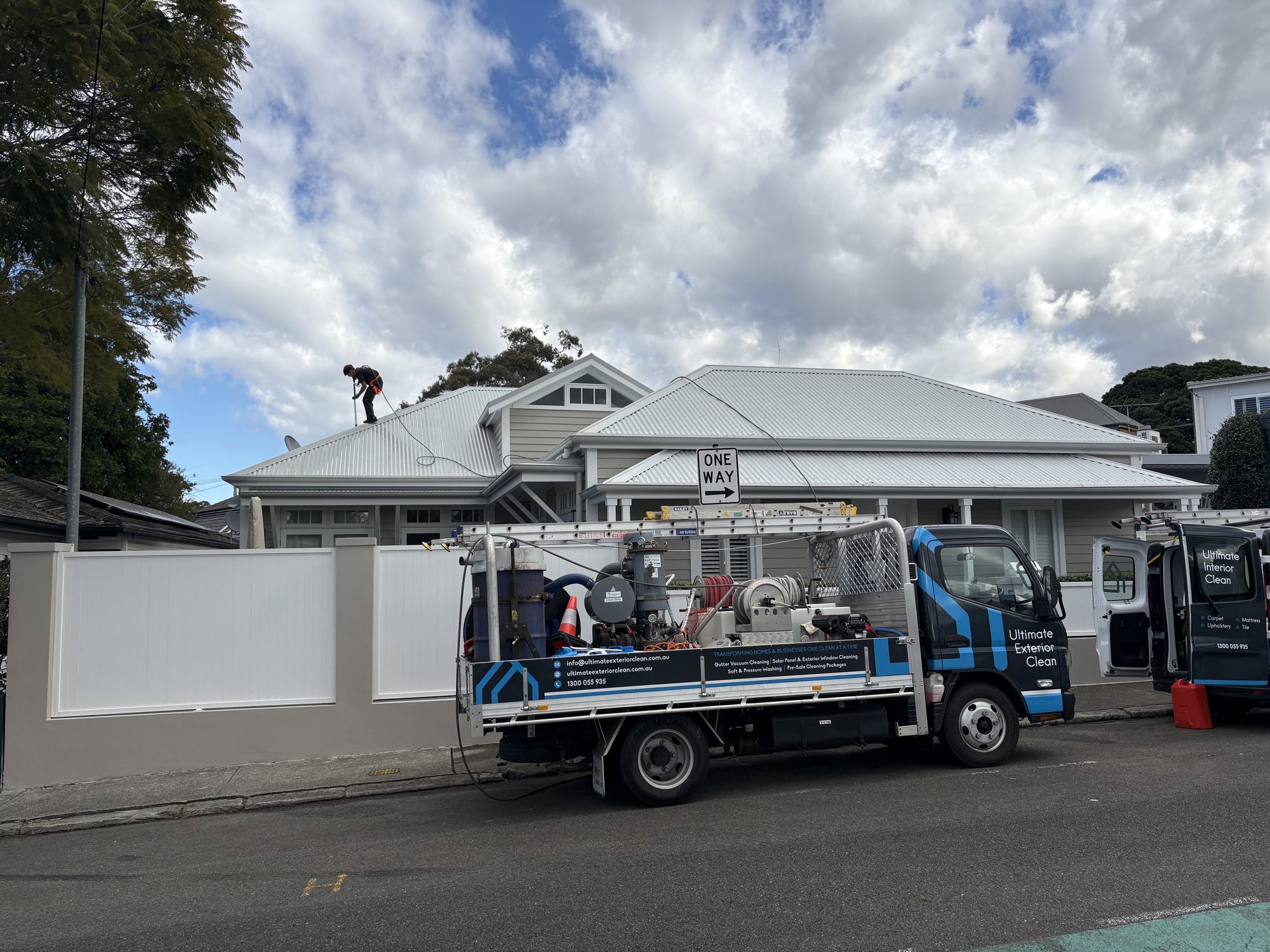
A 2020 heritage assessment describes Drummoyne's Federation heritage houses as face brick with half-timbering, leadlight and bay or oriel windows, under roofs of unglazed terracotta or slate. The roofing material decides the method. Unglazed terracotta is porous, and once lichen has rooted into it the growth is part of the surface rather than a layer on top. Slate, recorded at houses on St Georges Crescent and Lyons Road, is a different case: it can split along its layers under careless footing, and it is not one of the roof types listed for our roof cleaning, which covers concrete and terracotta tile and metal.
Some roofs carry ornament as well as tile. The house at 5 South Street, home of Henry Selfe from 1892, still has decorative iron lace running along its ridge, and original detail like that sits exactly where a careless cleaner would stand or aim a lance.
Exposure does the rest. Drummoyne is a low sandstone peninsula with water on three sides, and council's plan of management for the Drummoyne Oval precinct on Five Dock Bay notes it has no landform shelter from cold or salt-laden winds. Roofs facing the bays are open to similar weather. Salt dries on the tile and draws moisture back out of the air, and on the shaded side of a roof under brush box that damp surface is where lichen spreads fastest.
So each job starts with an inspection. We then choose between soft washing and controlled pressure for each surface, and finish with an anti-mould and lichen treatment to slow regrowth.
City of Canada Bay has more than 500 heritage items and 20 heritage conservation areas, and its Local Heritage Grants for 2023-24 offered owners of heritage items and contributory buildings up to $3,500 back toward retiling, repainting or tuckpointing. In other words, council has put money toward keeping these older buildings, roofs included, in good repair. Keeping the existing tiles clean and in service is the inexpensive end of that same aim.
Moss and lichen hold water against the clay, and on a salt-exposed roof that water carries salt into the tile's pores. Repeated wetting and drying of salt inside a porous material is one of the ways old tile slowly breaks down. Removing the growth, and applying a treatment that slows its return, takes much of that load off the roof.
The inspection itself has value. It gives you an honest picture of the roof before anything is cleaned, including any cracked or slipped tiles, and the before-and-after photos show what was removed and the condition the tiles and ridge were left in.
For a house being sold or leased, a clean roof also changes how the property reads from the street and in listing photos.
Not necessarily, but it needs the right approach. Unglazed tile is porous and old tiles can be brittle, so the roof is inspected first and the method is chosen to suit its condition, which may mean a soft wash rather than controlled pressure. The inspection is also the point at which any cracked or slipped tiles come to light.
Our roof cleaning covers concrete and terracotta tile and metal roofs, and slate is not on that list. Some Drummoyne Federation houses, including ones on St Georges Crescent and Lyons Road, are roofed in slate, which is brittle and can split along its layers underfoot. If yours is one of them, mention it when you call 1300 055 935 so it can be discussed before anything is booked.
Ridge ornament like the iron lace that survives at 5 South Street is noted during the inspection and worked around with care. Near it, the cleaning solution does the work at low pressure instead of a lance aimed at the joints and paint. Before-and-after photos record how the ironwork looked on either side of the clean.
The products we use are biodegradable and eco-friendly, and safe around gardens, pets and children. The treatment applied after cleaning is there to slow the return of moss and lichen on shaded and salt-exposed pitches. It reduces regrowth rather than stopping it permanently, which is worth knowing on the more exposed foreshore streets.
How we clean tile, terracotta and metal roofs across Sydney, what the process involves and what it costs.
Proudly serving Sydney with expert exterior cleaning.
MONDAY: 7:30 AM — 6:00 PM
TUESDAY: 7:30 AM — 6:00 PM
WEDNESDAY: 7:30 AM — 6:00 PM
THURSDAY: 7:30 AM — 6:00 PM
FRIDAY: 7:30 AM — 6:00 PM
SATURDAY: CLOSED
SUNDAY: CLOSED