Roofs feature heavily in the way council describes Lilyfield's protected streets. Its heritage sheets for the Austenham and Campbell estates both list unglazed terracotta tiles and some slate, and the Austenham sheet names terracotta ridging, restrained finials and chimneys among the decorative elements, while the smaller cottages of southern Lilyfield carry corrugated iron or tile. Cleaning any of them starts with an inspection rather than a pressure gun, because the method has to suit both the material and its age.
Unglazed terracotta sets the terms for roof cleaning here. Without a glaze the tile is more porous, so it takes up water and stays damp after a wet spell, and a damp, slightly rough surface is where lichen and moss establish most readily. On the Austenham Estate's hipped roofs, each house has pitches facing several directions, and the south-facing one, with the least sun, tends to be the first to green over.
Shade compounds it. Brush box planted in the roadway of the heritage streets can throw shade across front pitches where front gardens are small, and the narrow V-shaped gaps between neighbouring roofs can keep side pitches out of direct sun for long stretches. In the Campbell Estate, which sits almost flat on the high ground of the Lilyfield Road and Darling Street ridge, gables face the street, so the roof planes run down the sides of each house, and those facing a close neighbour can be slow to dry.
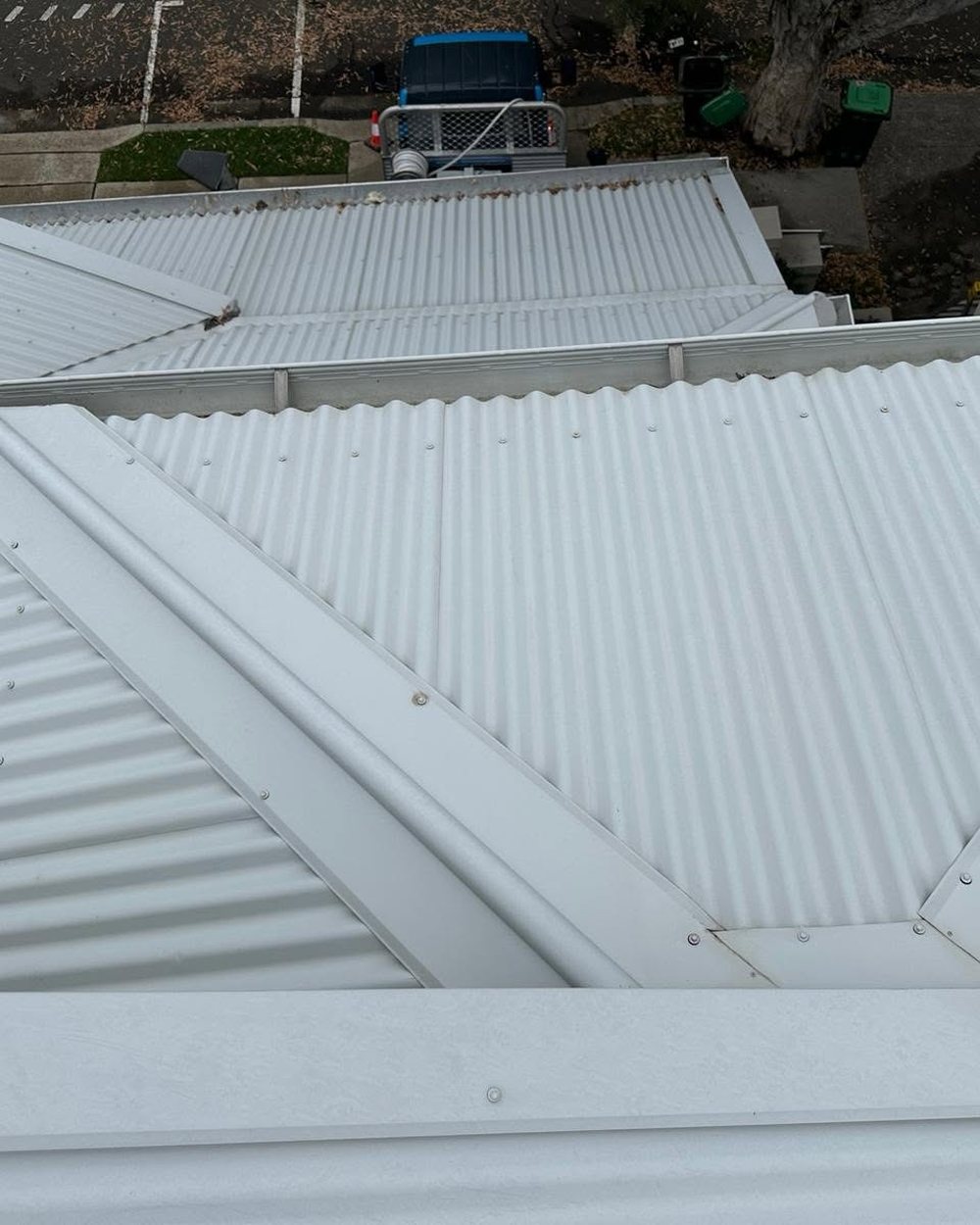
Further south, the brick and weatherboard cottages described by the Dictionary of Sydney carry corrugated iron as well as tile. Moss and lichen packed into the corrugations hold water against the sheeting, and on older iron that speeds up rust.
So every job starts with an inspection of the roof as a whole, ridging and chimneys included. From there we choose between a soft wash and controlled pressure cleaning for that particular roof, and finish with an anti-mould and lichen treatment to slow regrowth.
Across the Austenham and Campbell estates the roofline is a big part of what ties each street together. Runs of hipped and gabled terracotta, broken up by chimneys and the gaps between houses, are what council's conservation descriptions set out, and with small front gardens the street-facing pitches are in plain view of the footpath.
That makes keeping the existing tiles in good order the sensible approach. Lichen rooted into porous terracotta holds moisture in the tile, and years of wetting and drying can wear the surface. Clearing growth while the tiles are still sound helps put off the much bigger job of replacing them.
The anti-mould and lichen treatment is where the value carries forward. Shaded pitches under street trees will always attract growth, but slowing its return lengthens the gap between cleans.
For owners who have renovated one of the original workers' cottages, which investors have bought in large numbers, a clean roof finishes the job. Fresh paint and new joinery look half done under a blackened roof, and the before-and-after photos taken on every job record the difference.
Because the inspection comes before any cleaning, the roof's condition is looked at first, and cracked or slipped tiles are far better found while they are still a small repair.
That depends on choosing the right method, which is why we inspect the roof first. Unglazed terracotta is porous and older tiles can be fragile, so we decide between a soft wash and controlled pressure cleaning based on what we find. The aim is to lift moss, lichen and black streaks without stripping the tile's surface.
We do. Corrugated iron and Colorbond are both roofs we clean, along with concrete and terracotta tile. On metal, the main reason to clean is getting moss, lichen and grime out of the corrugations, where it holds moisture against the sheeting. The inspection beforehand is also a chance to look over the condition of older iron.
Those details are part of the roof we inspect before any cleaning, and the cleaning method is chosen with them in mind. Ridging, a finial or a chimney that is already loose or cracked is work for a roofer, so it pays to know its condition before cleaning starts.
There is no fixed answer, because regrowth depends on shade and moisture. A south-facing pitch under a brush box canopy will generally regrow faster than an open north-facing one. After cleaning we apply an anti-mould and lichen treatment, which slows regrowth so the roof stays cleaner for longer.
How we clean tile, terracotta and metal roofs across Sydney, what the process involves and what it costs.
Proudly serving Sydney with expert exterior cleaning.
MONDAY: 7:30 AM — 6:00 PM
TUESDAY: 7:30 AM — 6:00 PM
WEDNESDAY: 7:30 AM — 6:00 PM
THURSDAY: 7:30 AM — 6:00 PM
FRIDAY: 7:30 AM — 6:00 PM
SATURDAY: CLOSED
SUNDAY: CLOSED