Wahroonga has the grandest housing on the Upper North Shore and the roofs to match: slate, Marseille terracotta, deep gables and long valley runs on Federation and Arts and Crafts homes. Under this much canopy they green over steadily, and almost none of it will tolerate the pressure a modern tile roof shrugs off.
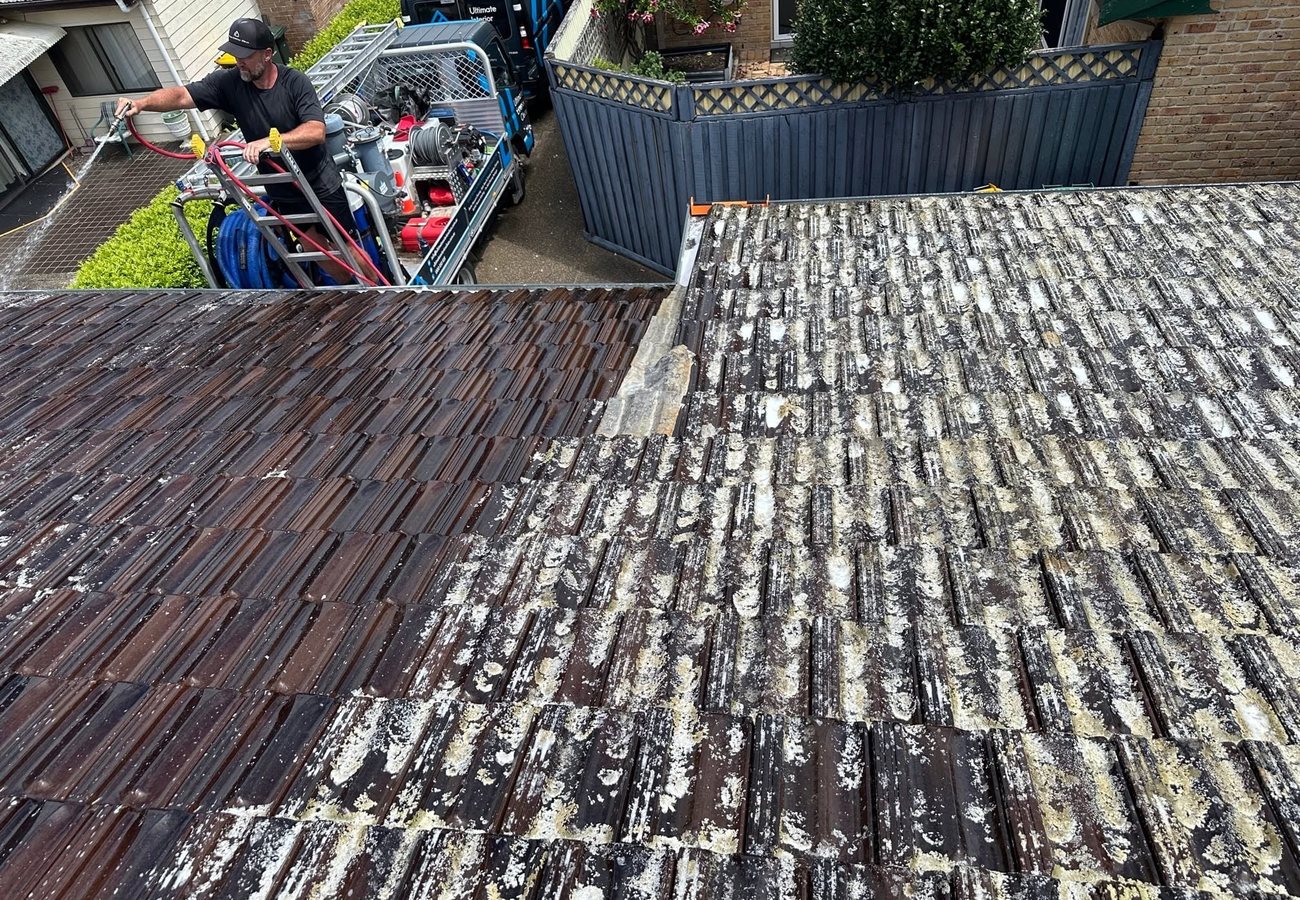
What separates Wahroonga from the rest of the Upper North Shore is the age and quality of what is on the roofs.
The conservation areas around Water Street and through Fox Valley hold Federation and Arts and Crafts houses built between the 1890s and the 1920s, and a great many still carry original slate or Marseille-pattern terracotta. Slate delaminates if walked carelessly and splits under pressure. Century-old terracotta has usually lost some glaze, so lichen roots into the clay rather than resting on it. Neither behaves like the unglazed concrete tile that dominates the newer Ku-ring-gai streets.
The gardens are the other factor, and they are unusually large. Mature exotic and remnant Blue Gum High Forest planting sits close to and often above these houses, so roof planes stay shaded for most of the day and hold moisture long after rain. Southern and south-eastern pitches carry thick growth rather than a surface film.
The roof forms compound it. Deep gables, dormers and long internal valleys make numerous debris traps, and the leaf and bark load through here is constant.
We work at low pressure chosen for the material, and treat slate and aged terracotta as the irreplaceable elements they are.
On a Wahroonga heritage roof the economics are unlike anywhere else on the Upper North Shore, because replacement is not a straightforward option.
Original slate and Marseille terracotta are not manufactured to these patterns any more. Matching means salvage or reproduction, both slow and expensive, and in a conservation area the council will have a view on what is permitted to go back up. A roof that would cost tens of thousands to replace on a modern house can cost multiples of that here, assuming a match can be found at all.
Under a canopy this heavy, growth is not a slow problem either. Lichen roots into de-glazed terracotta, and moss lifts slate and tile edges so water tracks sideways under the overlap instead of running off. That is how a sound century-old roof begins to leak, and on a house with lath and plaster ceilings and original cornice work the interior repair is specialist.
The valleys matter as much as the field. Long internal valleys under constant leaf load hold water against valley irons that are frequently at the end of their service life.
Cleaning on a sensible interval is what keeps all of that in the future rather than the present.
How we clean tile, terracotta and metal roofs across Sydney, what the process involves and what it costs.
Proudly serving Sydney with expert exterior cleaning.
MONDAY: 7:30 AM — 6:00 PM
TUESDAY: 7:30 AM — 6:00 PM
WEDNESDAY: 7:30 AM — 6:00 PM
THURSDAY: 7:30 AM — 6:00 PM
FRIDAY: 7:30 AM — 6:00 PM
SATURDAY: CLOSED
SUNDAY: CLOSED