Wahroonga arrays are usually working with less light than the brochure assumed. The gardens here are mature and frequently taller than the houses, so a system installed in clear sun a decade ago may now be shaded for part of the day, and every percentage point lost to dirt comes off an already reduced base.
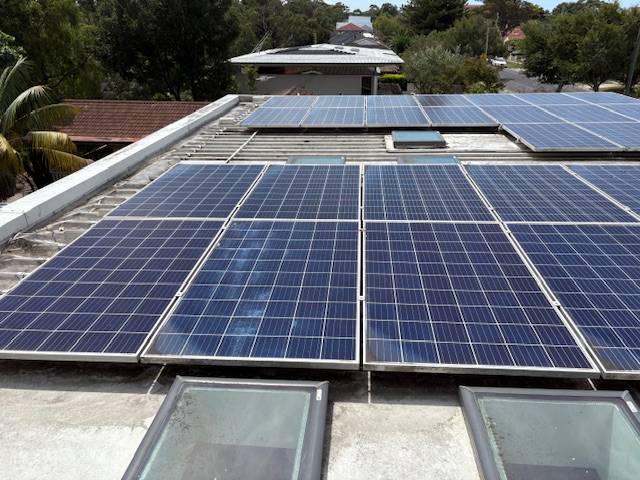
The gardens are the defining feature of solar in Wahroonga, and they work against an array in two ways.
The first is shade. Mature exotic and remnant Blue Gum High Forest planting on these large blocks has kept growing since most of these systems were installed, so partial shading across part of the day is common. Because cells run in series, even partial shading across a row constrains the whole string rather than costing a proportional share.
The second is what those trees drop. Leaf, bark and seed land on the glass constantly rather than seasonally, and wedge along the lower frame of each row where they hold moisture against the panel and its seal. Wet eucalypt litter leaches tannin that dries as a bonded brown film, and spring brings a heavy pollen load off the surrounding forest.
Roof access is a genuine constraint. These are large two-storey houses with steep, complex Federation roofs in slate or terracotta, neither of which is a forgiving surface to work on.
We clean with purified water and a soft brush, no detergent, and work from roof ladders with height-safety equipment rather than walking the array or the heritage roof around it.
Because there are two plausible reasons a Wahroonga array underperforms, cleaning it is the cheapest way to find out which one you have.
If generation recovers after a clean, the problem was soiling and the fix is a sensible interval. If it does not, you have learned that the canopy has grown into the system, which is worth knowing before spending money on extra panels or a battery on the assumption that the hardware has degraded. That diagnostic value is real and most owners never get it.
Where the array is already giving up hours to shade, soiling matters more rather than less, since every additional loss comes off a smaller base.
The tannin staining is the part that compounds if ignored. It bonds progressively, so a system left for years needs far more work to restore than one cleaned on schedule.
And the litter lodged along the lower frame holds moisture against the panel seal continuously, which is the failure mode that costs hardware rather than output.
On a steep slate or terracotta roof this is height-safety work, and not something to attempt from a domestic ladder.
How we clean arrays with purified water and no detergent, and why output recovers once the glass is clear.
Proudly serving Sydney with expert exterior cleaning.
MONDAY: 7:30 AM — 6:00 PM
TUESDAY: 7:30 AM — 6:00 PM
WEDNESDAY: 7:30 AM — 6:00 PM
THURSDAY: 7:30 AM — 6:00 PM
FRIDAY: 7:30 AM — 6:00 PM
SATURDAY: CLOSED
SUNDAY: CLOSED