On a Hornsby array the litter that matters most is often the litter you cannot see. Leaf and bark blow under the panels and collect in the cavity between the array and the roof, where it stays dry, holds nothing back in an ember attack, and never gets cleared by rain or by a quick wipe of the glass.
Hornsby arrays sit in the middle of a working bushland environment, and that produces a maintenance problem with two halves.
Above the panels, the surrounding blackbutt, peppermint and angophora shed leaf, bark and twig continuously rather than seasonally. That material lands on the glass and wedges along the lower frame of each row, where it holds moisture against the panel and its seal and leaches a brown tannin that dries as a bonded stain.
Below the panels is the part most owners never think about. Wind drives litter into the cavity between the array and the roof sheeting, where it accumulates, dries out and stays. On a property in a bushfire-prone area that is dry fuel sitting on a roof, directly under equipment carrying live DC wiring. Clearing the glass alone does not touch it.
Shading is a genuine factor too. Under this much canopy, and on blocks that fall into gullies, an array can lose meaningful hours of usable sun, which makes every additional percentage point lost to soiling more costly against an already reduced base.
We clean with purified water and a soft brush, clear the debris that has collected around and beneath the array, and work from height-safety equipment rather than walking the panels.
The reason to have a Hornsby array cleaned properly rather than hosed is that the two biggest problems are not on the glass.
The first is the litter beneath the panels. In a bushfire-prone area, dry leaf and bark packed into the cavity between an array and the roof is fuel in the worst possible location, and it is not something an owner can reach or see. Clearing it is a fire-preparation task as much as a performance one.
The second is the tannin bonded to the glass. Wet eucalypt litter left sitting on a panel leaves a brown film that becomes progressively harder to remove, so a system left for years needs considerably more work to restore than one cleaned on a sensible interval.
On performance, the shading here makes soiling matter more rather than less. An array already giving up hours to canopy and gully shadow is working from a reduced base, so the proportional impact of a dirty panel is larger than it would be on an open roof.
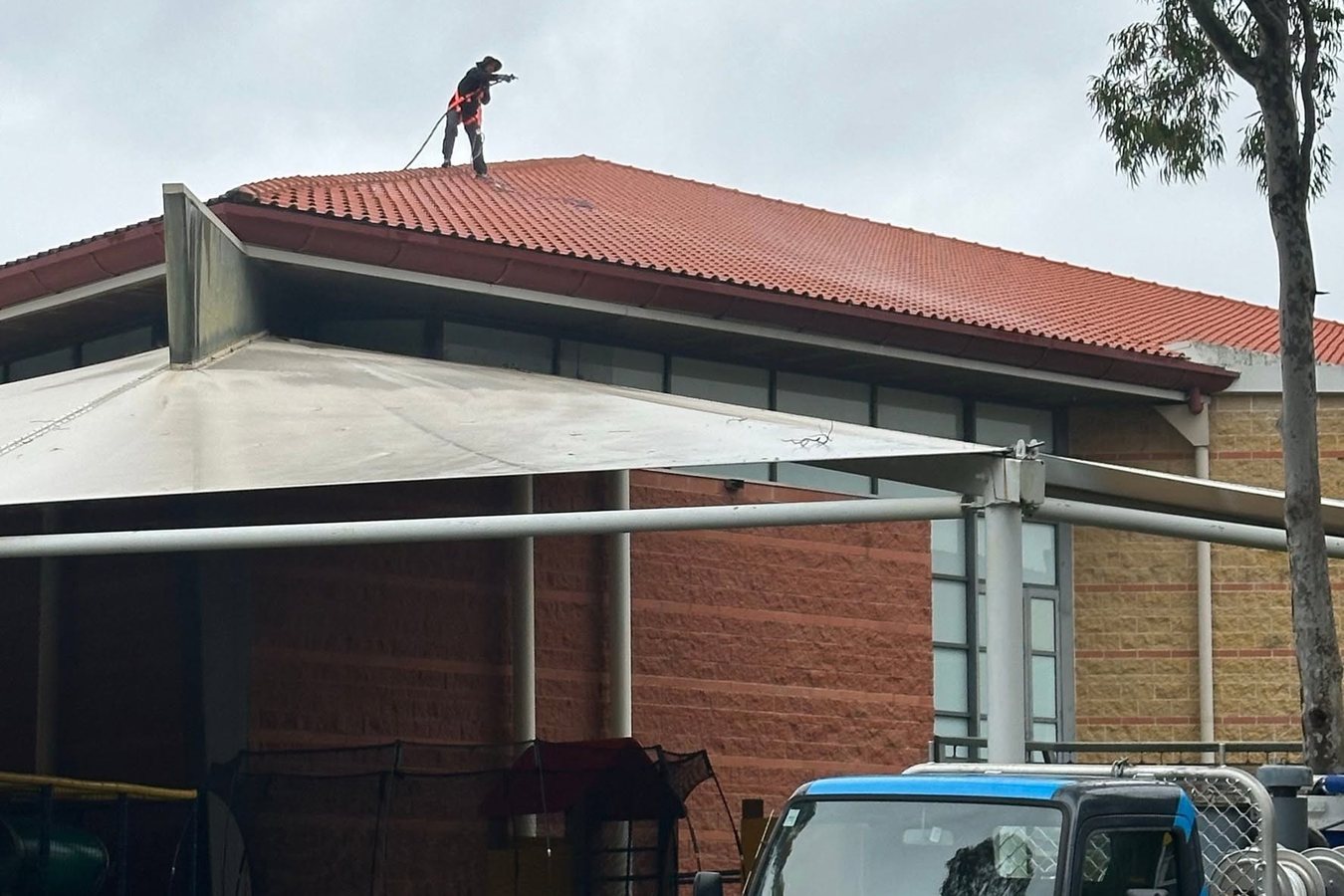
These are steep roofs on stepped blocks. This is height-safety work, not something to attempt from a domestic ladder.
How we clean arrays with purified water and no detergent, and why output recovers once the glass is clear.
Proudly serving Sydney with expert exterior cleaning.
MONDAY: 7:30 AM — 6:00 PM
TUESDAY: 7:30 AM — 6:00 PM
WEDNESDAY: 7:30 AM — 6:00 PM
THURSDAY: 7:30 AM — 6:00 PM
FRIDAY: 7:30 AM — 6:00 PM
SATURDAY: CLOSED
SUNDAY: CLOSED