A lot of Hornsby backs directly onto bushland reserve, and the gutters carry the consequences. The litter arrives year round rather than in an autumn burst, the blocks fall away into gullies so the reach is awkward, and many properties sit inside an asset protection zone where a packed gutter is a genuine hazard rather than an inconvenience.
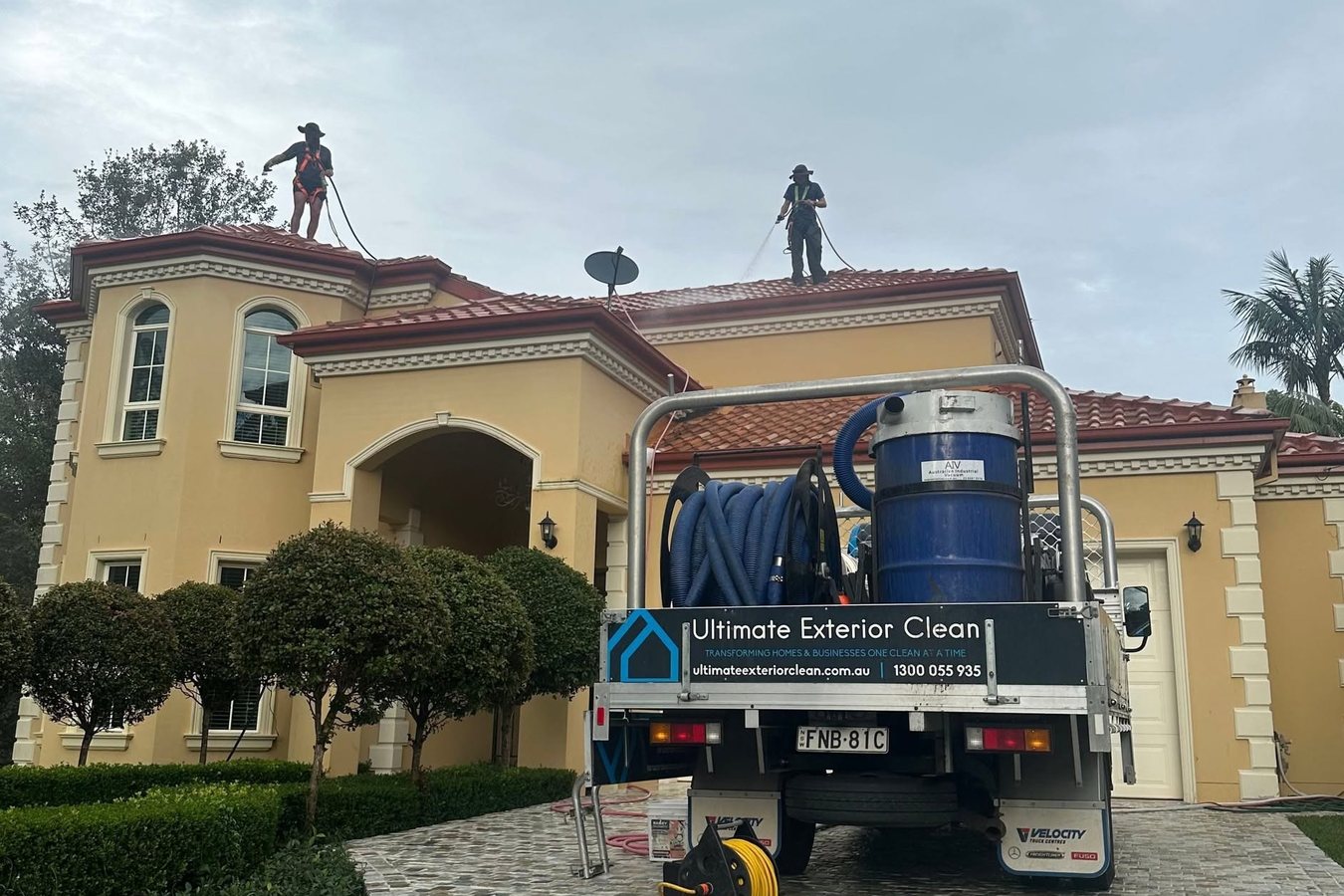
Hornsby's geography puts more material into its gutters than almost anywhere we work, and makes it harder to get at.
The suburb sits on sandstone cut by steep gullies running toward Berowra Valley, and a large share of properties adjoin bushland reserve on at least one boundary. Blackbutt, Sydney peppermint and angophora drop leaf, bark and twig continuously rather than seasonally, so there is no month when these gutters are genuinely clear. Bark is the worst of it: long strips that dam a run rather than washing through.
Topography does the rest. Houses step down their blocks, so the rear gutter on a single-storey street frontage can be two storeys above the ground at the back, over a gully, a retaining wall or bush. There is often nowhere to safely foot a ladder anywhere near the section that needs clearing.
Many properties here also sit within a mapped asset protection zone, and dry litter packed into gutters is precisely the fuel that ignites in an ember attack.
Rainwater tanks are common too, and everything sitting in the gutter is what ends up in the tank.
Vacuum clearing pulls the packed material out completely from ground level, and we clear downpipes rather than flushing debris toward them.
The standard advice to clear gutters twice a year assumes a suburban street with street trees. On a Hornsby property backing onto reserve that interval is simply too long.
The practical benefit of recognising that is straightforward: you clear often enough to keep ahead of a load that never stops arriving. A property adjoining bushland can fill a gutter in a season, and one cleared on a generic annual schedule spends much of the year carrying material that a suburb with open sky would never accumulate.
What it protects is significant. Overflow on these homes runs behind the fascia into the eaves, and on a stepped block that water tracks along the structure rather than away from it. Downpipes are the under-appreciated part, because fine litter that washes past the gutter lodges at the bend and pushes the overflow somewhere less obvious, frequently into a stormwater pit that then backs up on a slope.
For anyone running a rainwater tank, clearing directly affects water quality for irrigation and household use.
And in an asset protection zone, a clear gutter is one of the cheapest pieces of fire preparation available, done from the ground rather than off a ladder on a sloping block.
How vacuum gutter clearing works, what we check while we are there, and what it costs across Sydney.
Proudly serving Sydney with expert exterior cleaning.
MONDAY: 7:30 AM — 6:00 PM
TUESDAY: 7:30 AM — 6:00 PM
WEDNESDAY: 7:30 AM — 6:00 PM
THURSDAY: 7:30 AM — 6:00 PM
FRIDAY: 7:30 AM — 6:00 PM
SATURDAY: CLOSED
SUNDAY: CLOSED