Hornsby earns the Bushland Shire name, and roofs pay for it. Properties back onto gullies and reserve, the eucalypt canopy drops litter onto them all year, and the concrete tile used across the suburb's 1960s to 1980s housing holds enough moisture for moss to establish thickly rather than as a thin film.
Hornsby sits on Hawkesbury sandstone, cut through by steep gullies running down toward Berowra Valley and the Lane Cove catchment, and that topography drives everything about the roofs.
Houses here frequently back directly onto bushland reserve, so the leaf, bark and twig fall is continuous rather than seasonal. Blackbutt, Sydney peppermint and angophora shed year round, and the material lands on roofs and stays there. The gullies also hold cold air and moisture, so the southern and south-eastern pitches on a property that falls away to the rear can stay damp for days after rain.
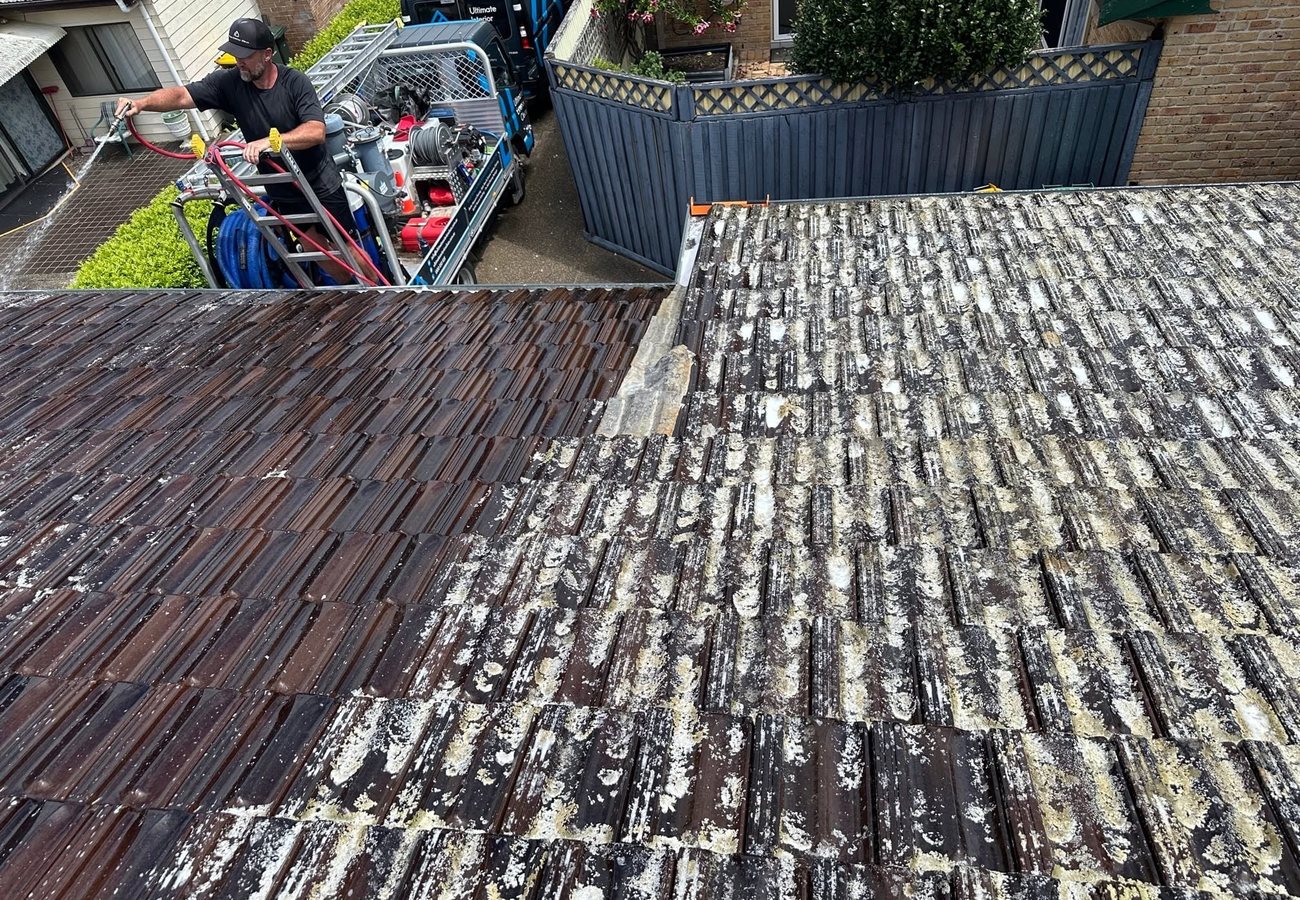
The housing is dominated by 1960s through 1980s brick homes roofed in unglazed concrete tile. That tile is far more absorbent than glazed terracotta, and combined with permanent shade it produces thick, cushiony moss that lifts tile edges rather than the thin algae film open suburbs get.
There is a fire dimension that does not apply in most of the suburbs we service. Much of Hornsby is mapped as bushfire prone, and dry litter accumulating in roof valleys and behind ridge capping is exactly the fuel an ember attack looks for.
We soft wash rather than blast so the tile face and ridge pointing survive, and we clear valleys and gutters in the same visit so there is less fuel and less feeding the growth.
Two things make roof cleaning in Hornsby worth doing on a schedule rather than when you notice it.
The first is what thick moss does mechanically. Unlike a surface film it holds water permanently against the tile and lifts the tile edge as it establishes, letting water track sideways under the overlap instead of running off. That is how a sound roof starts leaking, and the first sign is usually a ceiling stain rather than anything visible from the garden. Left long enough it works into the ridge pointing, and repointing a large roof on a sloping block is a serious expense.
The second is fire preparation. In a bushfire-prone area, dry litter sitting in valleys and behind ridge capping is the most common ignition point in an ember attack, and clearing the roof removes that fuel along with the growth. NSW RFS preparation advice puts it near the top of the list for good reason.
There is a drainage benefit as well. The moss and litter shedding off a roof is what fills the gutters below it, so a clean roof means gutters that block more slowly.
On the steep blocks common here this is height-safety work rather than a weekend job.
How we clean tile, terracotta and metal roofs across Sydney, what the process involves and what it costs.
Proudly serving Sydney with expert exterior cleaning.
MONDAY: 7:30 AM — 6:00 PM
TUESDAY: 7:30 AM — 6:00 PM
WEDNESDAY: 7:30 AM — 6:00 PM
THURSDAY: 7:30 AM — 6:00 PM
FRIDAY: 7:30 AM — 6:00 PM
SATURDAY: CLOSED
SUNDAY: CLOSED