Owners here often assume the rain does the job. In Turramurra it genuinely does not. More rain simply means wet litter sits on the glass for longer, leaching tannin into a bonded film, while dry material collects in the cavity underneath the panels where no amount of weather reaches it.
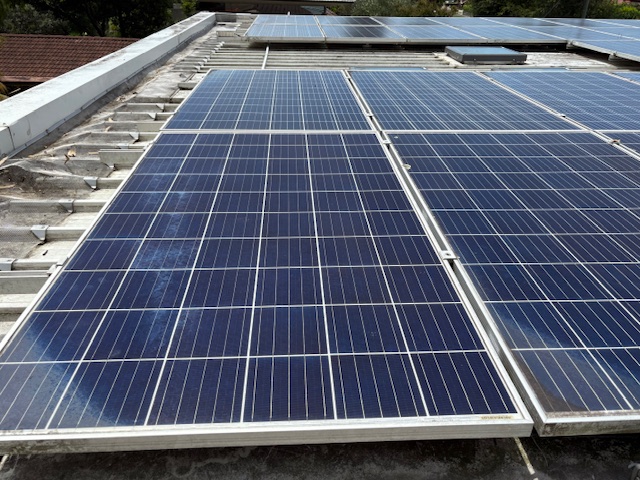
Turramurra gives an array a specific combination: high rainfall, continuous litter and deep shade.
Sitting high on the ridge, the suburb takes noticeably more rain than the coastal suburbs. That does not clean a panel. Wet eucalypt litter held on the glass leaches a brown tannin that dries as a bonded stain, so frequent rain on a dirty array produces staining rather than clearing.
The litter itself never stops, because Ku-ring-gai Chase falls away to the north and Lane Cove National Park to the south, and blackbutt, blue gum and angophora shed leaf, bark and twig year round. It wedges along the lower frame of each row and holds moisture against the panel seal.
Underneath is the part owners never see. Wind drives litter into the cavity between the array and the roof sheeting, where it accumulates and dries out. On blocks that sit in bushfire-prone gullies that is dry fuel on a roof, directly beneath equipment carrying live DC wiring.
Gully shade cuts available light further, which makes every additional loss more costly.
We clean with purified water and a soft brush, clear the debris around and beneath the array, and work from height-safety equipment on roofs that step down steeply.
The single most useful correction for an owner here is that rainfall is not maintenance.
In a suburb that takes this much rain it is tempting to assume the panels look after themselves. What actually happens is that wet litter sits on the glass and stains it, and the stain bonds harder each season. A system left on that basis for several years needs considerably more work to restore than one cleaned on a sensible interval.
The litter beneath the array is the second thing rain cannot touch, and it is the more serious of the two. In a bushfire-prone gully, dry leaf and bark packed into the cavity between panels and roof sheeting is fuel in the worst possible position, and it is not something an owner can see or reach. Clearing it is fire preparation as much as performance work.
On output, gully shade means the array is already working from a reduced base, so the proportional cost of soiling is higher here than on an open roof.
These are steep roofs on blocks that fall away sharply. This is height-safety work rather than a weekend job.
How we clean arrays with purified water and no detergent, and why output recovers once the glass is clear.
Proudly serving Sydney with expert exterior cleaning.
MONDAY: 7:30 AM — 6:00 PM
TUESDAY: 7:30 AM — 6:00 PM
WEDNESDAY: 7:30 AM — 6:00 PM
THURSDAY: 7:30 AM — 6:00 PM
FRIDAY: 7:30 AM — 6:00 PM
SATURDAY: CLOSED
SUNDAY: CLOSED