An array in St Ives works under the heaviest tree cover of any suburb we service. Leaf and bark land on the panels constantly, spring pollen coats them, and tannin from wet litter leaves a stain that rain will not shift. Arrays here need attention far more often than the industry rule of thumb suggests.
Most solar advice assumes an open roof under open sky. St Ives is the opposite case, and it changes the maintenance interval substantially.
The tall forest through the suburb drops leaf, bark and seed capsule onto panels year round. Unlike dust, that material does not blow off. It wedges along the lower frame of each row and stays there, holding moisture against the glass and the panel seal. Wet eucalypt litter leaches tannin, which dries as a brown stain bonded to the glass surface.
Spring adds a heavy pollen load from the surrounding forest. Pollen is fine enough to form an even film across the whole array, so there is no visible dirty patch to prompt a clean, and output simply drops without any obvious cause.
The panel wiring makes the lodged litter worse than it looks. Cells run in series within each panel, so a band of debris shading the bottom edge of a row does not cost a proportional slice of output, it constrains the entire string behind it.
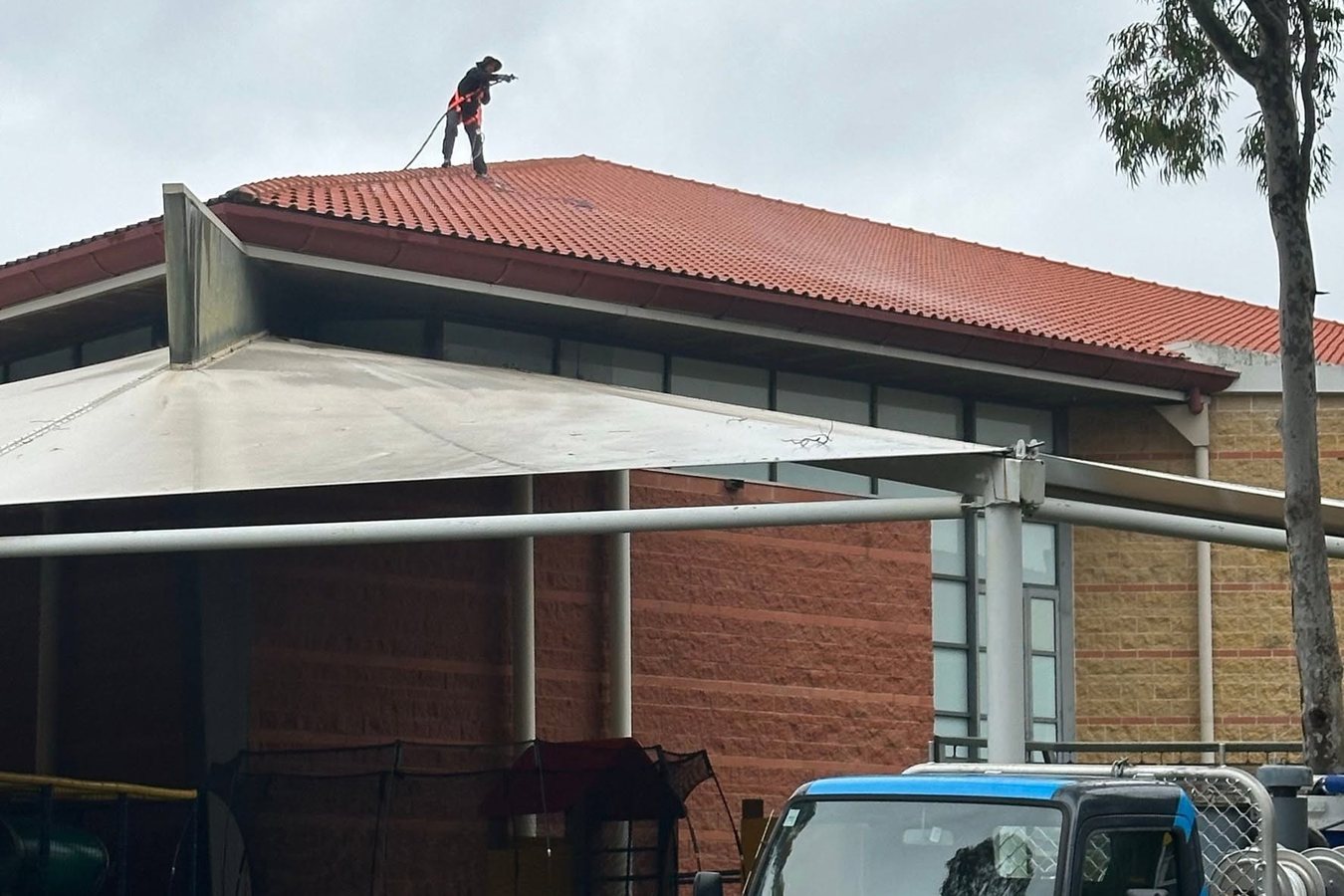
We clean with purified water and a soft brush, no detergent, working from roof ladders and height-safety gear rather than walking the array.
The standard advice on solar cleaning assumes an open roof. Applying that interval in St Ives is how systems here end up chronically underperforming.
The practical benefit of recognising this is simply that you clean often enough. Under this much canopy an array accumulates leaf, bark and pollen continuously, and a system cleaned on a generic annual schedule spends much of the year carrying material that a suburb with open sky would never accumulate. Matching the interval to the actual conditions is what recovers the output.
The tannin staining is the part that compounds. Wet eucalypt litter left on glass bonds a brown film that becomes progressively harder to remove, so a system left long enough needs more work to restore than one cleaned on schedule.
There is a fire-adjacent benefit too. Dry leaf litter accumulating between and beneath panels sits on a roof in a bushfire-prone LGA, and clearing the array removes that fuel along with the shading.
Because these are large two-storey homes, this is height-safety work rather than something to attempt off a ladder.
How we clean arrays with purified water and no detergent, and why output recovers once the glass is clear.
Proudly serving Sydney with expert exterior cleaning.
MONDAY: 7:30 AM — 6:00 PM
TUESDAY: 7:30 AM — 6:00 PM
WEDNESDAY: 7:30 AM — 6:00 PM
THURSDAY: 7:30 AM — 6:00 PM
FRIDAY: 7:30 AM — 6:00 PM
SATURDAY: CLOSED
SUNDAY: CLOSED