Manly gets excellent sun and punishes the equipment that collects it. Salt arrives from the ocean and the harbour, gulls treat rooftops as a perch, and Norfolk Island pine needles lodge along the lower frame of every row. All three reduce output, and only one of them is visible from the ground.
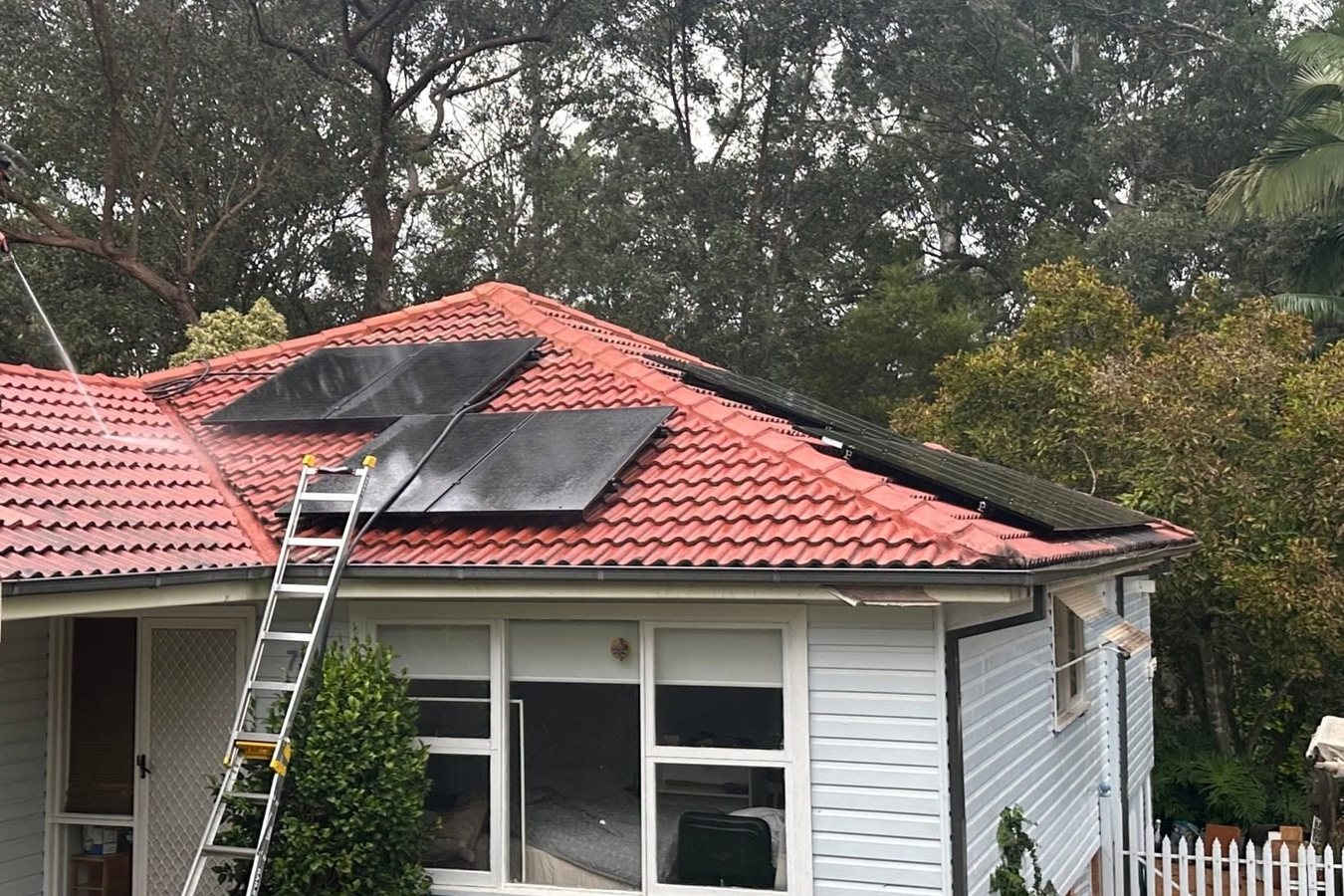
An array in Manly is exposed on two sides, which is unusual even by coastal standards, and each source contributes something different.
Salt is the constant. Because it is hygroscopic it stays faintly damp instead of drying to a dust that blows away, and it binds windblown sand and pollen into a film bonded to the glass. Rain rinses the loose material and leaves the bonded layer, and because it builds evenly across the whole array there is no dirty patch to prompt a clean. Output simply drifts downward.
Gulls are the sharper problem. Rooftops here are perches, and droppings are opaque rather than translucent, so they block a cell rather than dimming it. With cells wired in series, one blocked cell throttles the current for its entire string, which is why a few small marks cost far more than their area suggests.
Norfolk Island pine needles are the third. They are fine, shed year round, and wedge along the lower frame of each row where they hold salt-laden moisture against the glass and the panel seal.
We clean with purified water and a soft brush, no detergent, and work from roof ladders and height-safety gear on streets where access is genuinely tight.
A solar system is bought on a payback period, and in Manly there are three separate things quietly extending it.
The salt film is the one nobody sees, because it builds uniformly and produces no visual trigger. The gull fouling is the one that costs the most relative to its size, because a few opaque marks can throttle whole strings. The pine needles are the one that does the most long-term damage, because trapped organic material holds moisture permanently against the panel seal, and that seal is the part of a panel least able to tolerate it.
Left long enough, droppings bake on and become acidic enough to etch the glass, which converts a maintenance issue into a hardware one no cleaning will reverse.
Cleaning with purified water and no detergent matters more here than in most suburbs, because a detergent residue gives salt something to key into and brings the film back faster. Purified water leaves nothing behind and dries without mineral spotting.
On these narrow, steep streets the access itself needs planning, and this is height-safety work rather than a job to attempt off a ladder.
How we clean arrays with purified water and no detergent, and why output recovers once the glass is clear.
Proudly serving Sydney with expert exterior cleaning.
MONDAY: 7:30 AM — 6:00 PM
TUESDAY: 7:30 AM — 6:00 PM
WEDNESDAY: 7:30 AM — 6:00 PM
THURSDAY: 7:30 AM — 6:00 PM
FRIDAY: 7:30 AM — 6:00 PM
SATURDAY: CLOSED
SUNDAY: CLOSED