Solar in Mosman fights the tree canopy twice over. The shade itself costs you generation, and the same trees drop leaf, bark and seed onto the panels, where it lodges along the lower frame and stays damp. Panels here need clearing more often than a suburb with open sky.
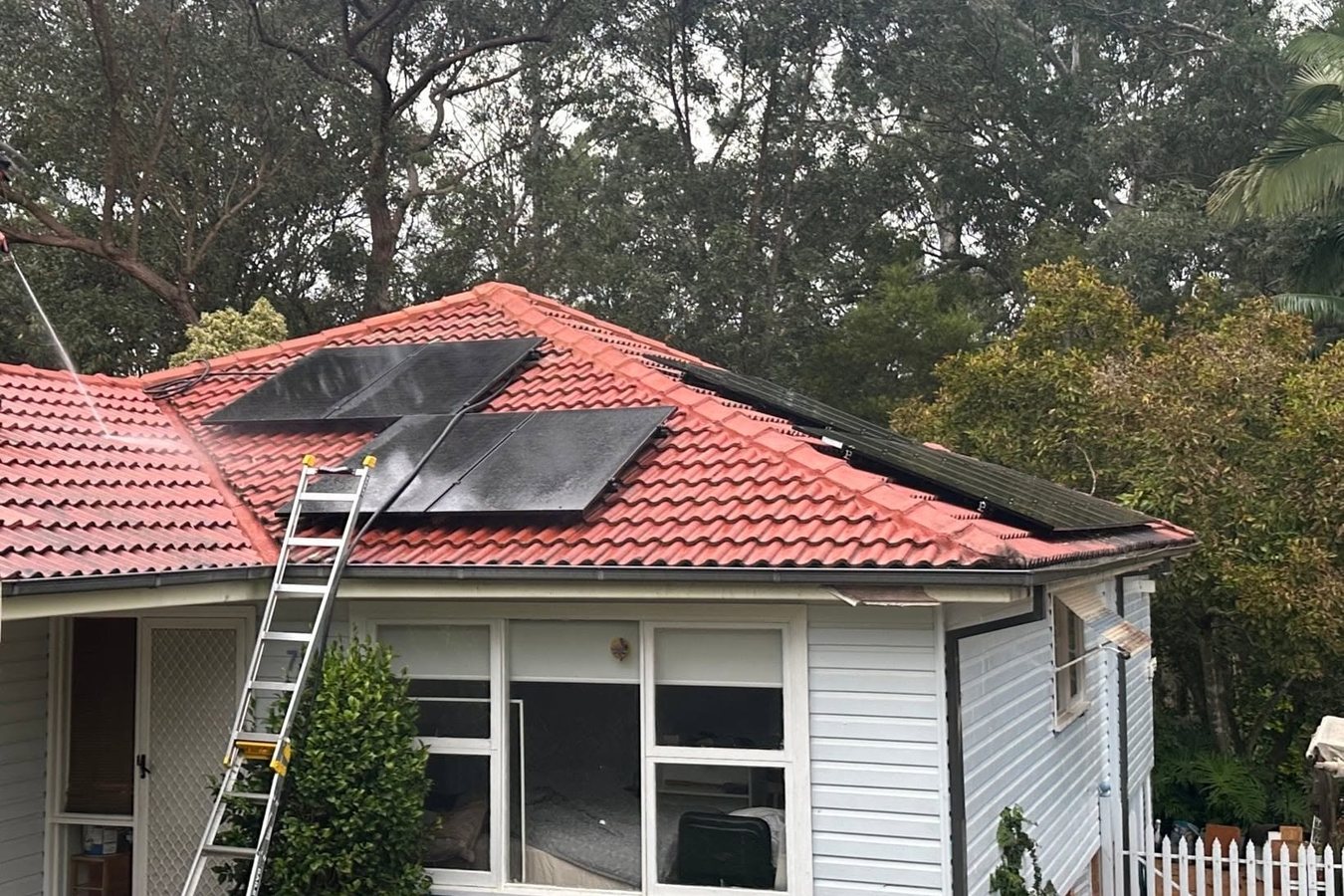
Mosman's canopy is the defining factor for any array in the suburb. Angophoras, blue gums and figs sit above roof height on many blocks, and the debris they drop does not blow off a panel the way dust does. Bark strips and gum leaves catch on the frame at the lower edge of each row, hold water against the glass and the seal, and leave a tannin stain that ordinary rain will not lift.
That lodged litter matters more on solar than on a roof generally, because of how panels are wired. Cells within a panel run in series, so shading a strip along one edge does not cost you a proportional slice of output, it drags down the whole string. A band of leaf litter across the bottom of a row is one of the most expensive kinds of dirt you can have.
Roof pitch is the other consideration. Federation-era roofs here are steep, and the blocks fall away sharply toward the water, so a two-storey house on the downhill side presents a genuine height and access problem.
We work from roof ladders with height-safety equipment rather than walking the array, and clean with purified water and a soft brush so nothing abrasive touches the glass and no mineral spotting is left as it dries.
If your array is already giving up generation to the tree canopy, the case for keeping the glass clear is stronger here than almost anywhere.
That is the argument in short. A Mosman system is usually working with less available light to begin with, because the surrounding angophoras and figs shade parts of the roof for portions of the day. Every additional percentage point lost to leaf litter, bark and tannin staining comes off an already reduced base, which makes the proportional impact of a dirty array larger than it would be on an open roof in a treeless suburb.
There is a hardware protection argument as well. Wet organic litter trapped along the lower frame holds moisture against the panel seal continuously, and that is the part of a panel most vulnerable to long-term water ingress.
Access is the other consideration, and it is a safety one. These are steep roofs on blocks that fall away sharply, and cleaning an array here is genuinely not a job to attempt from a domestic ladder.
We work with proper height-safety equipment and never walk on the panels themselves.
More. When angophoras and figs already shade parts of the roof for portions of the day, the array starts with less available light. Every point lost to leaf, bark and tannin staining comes off that smaller base, so the proportional impact of dirty glass is larger than on an open roof.
Bark strips and gum leaves from canopy above roof height catch on the lower frame of each row instead of blowing off like dust. They hold water against the glass and leave a tannin stain that ordinary rain won't lift. Because the canopy keeps dropping, the build-up returns quicker than on an exposed roof.
Federation-era roofs here are steep, and blocks drop away toward the water, so a two-storey house on the downhill side is a genuine height and access problem. We use roof ladders with height-safety equipment, never walk on the panels, and our team is certified for working at heights.
The method is designed to avoid both. We use purified water and a soft brush, so nothing abrasive touches the glass and no mineral spotting is left as it dries. Bark and leaf caught along the lower edge are cleared too, taking away the moisture held against the panel seal. You receive before-and-after photos once the clean is finished.
How we clean arrays with purified water and no detergent, and why output recovers once the glass is clear.
Proudly serving Sydney with expert exterior cleaning.
MONDAY: 7:30 AM — 6:00 PM
TUESDAY: 7:30 AM — 6:00 PM
WEDNESDAY: 7:30 AM — 6:00 PM
THURSDAY: 7:30 AM — 6:00 PM
FRIDAY: 7:30 AM — 6:00 PM
SATURDAY: CLOSED
SUNDAY: CLOSED