Manly's art deco walk-ups and Federation semis were rendered and painted for a coastal position, but nothing survives salt on two sides indefinitely. The film that dulls these facades is salt holding airborne dust in place, and on original render and painted timber detailing it has to be dissolved rather than blasted off.
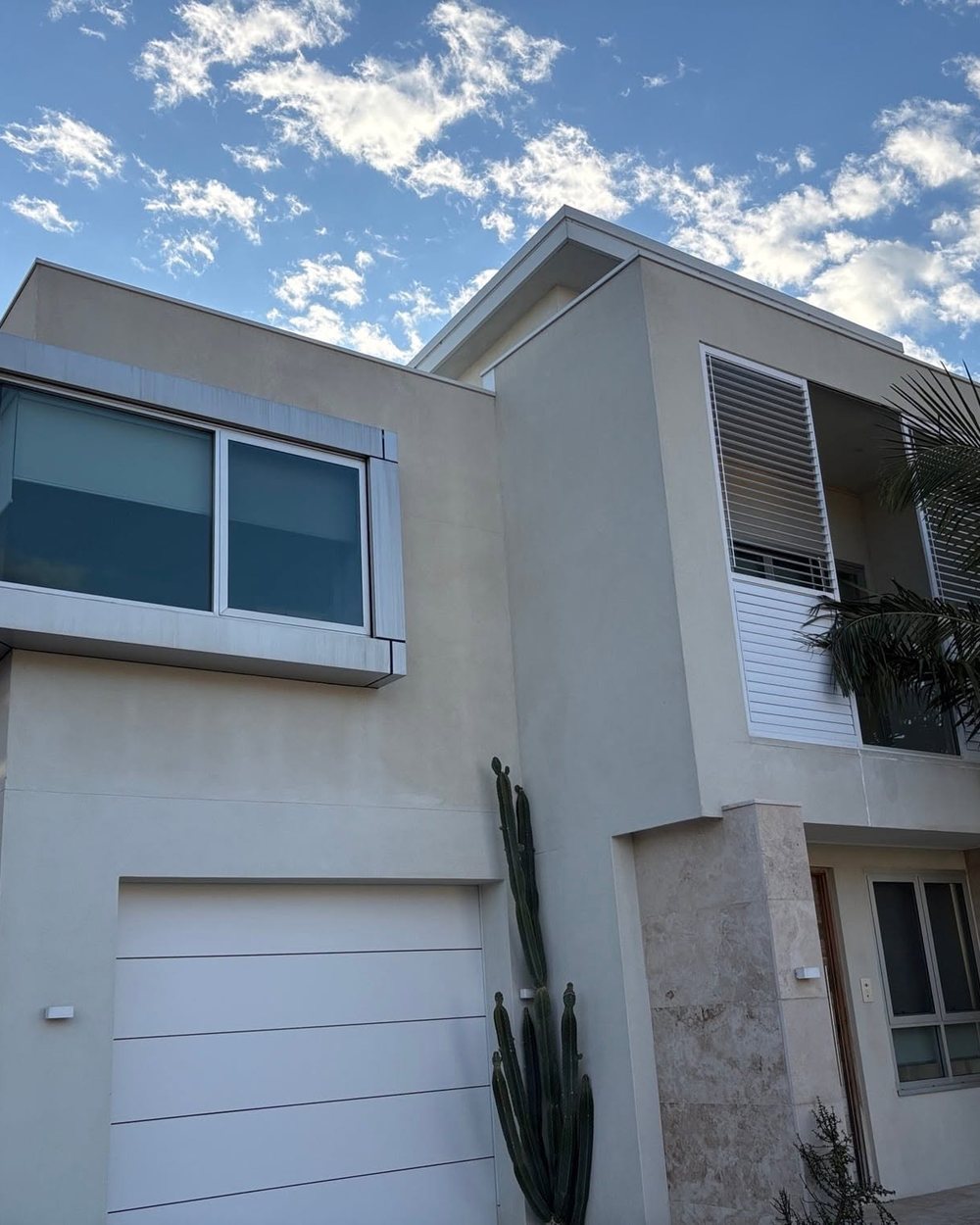
With the ocean on one side and the harbour on the other, Manly gives a wall nowhere to hide.
Salt is hygroscopic, so instead of drying to a dust that blows away it stays faintly damp and grips the airborne sand and dust that lands on it. That builds an even grey film across a whole elevation, which is why owners so often read it as the paint having faded rather than the wall being dirty. It is worst on the exposed seaward faces, which are usually the ones with the view and the most glazing.
The harbour side of the suburb behaves differently. It is shadier and more sheltered, so instead of an even salt film you get mould concentrating on southern walls and anywhere planting sits close to the render.
The building fabric is the constraint. The art deco and interwar walk-ups have original render with moulded detailing, the Federation semis carry painted timber fretwork, barge boards and window joinery, and the conservation areas mean a lot of it is original. Pressure gets behind a paint film, lifts it, and turns a wash into a preparation job.
We use low pressure, a biodegradable solution and dwell time, then rinse thoroughly with fresh water so the salt is carried off rather than left to draw moisture back in.
Exterior paint in Manly is working harder than paint almost anywhere else in Sydney, and understanding why is what makes the maintenance case obvious.
Salt film sitting on a rendered or painted wall holds moisture against the coating continuously and feeds the mould growing in it. A coating under that combination chalks and fails well short of the interval the manufacturer quotes, and with exposure from two directions there is no sheltered elevation to average it out. Repainting a building here is a major expense; washing it every couple of years costs a fraction and measurably extends the gap between repaints.
Underneath the coating there is fabric worth protecting. Render that stays damp behind a failing film blisters and cracks, and on the art deco stock the moulded detailing is not a straightforward patch. Original painted timber on the Federation semis rots once water gets behind the paint.
Rinsing matters as much as washing. Purified rinsing carries the salt away rather than leaving it on the surface to draw moisture straight back in, which is why a properly finished job holds far longer here than a quick scrub.
Why low pressure is the right method for render, painted brick and weatherboard, and what the process involves.
Proudly serving Sydney with expert exterior cleaning.
MONDAY: 7:30 AM — 6:00 PM
TUESDAY: 7:30 AM — 6:00 PM
WEDNESDAY: 7:30 AM — 6:00 PM
THURSDAY: 7:30 AM — 6:00 PM
FRIDAY: 7:30 AM — 6:00 PM
SATURDAY: CLOSED
SUNDAY: CLOSED