Dee Why roofs take wind as much as salt. The suburb rises steeply from the beach to the headland, and the higher and more exposed a roof sits, the harder the onshore weather drives salt into tile joints and sheet profiles. Low-pitch strata roofs collect it worst of all.
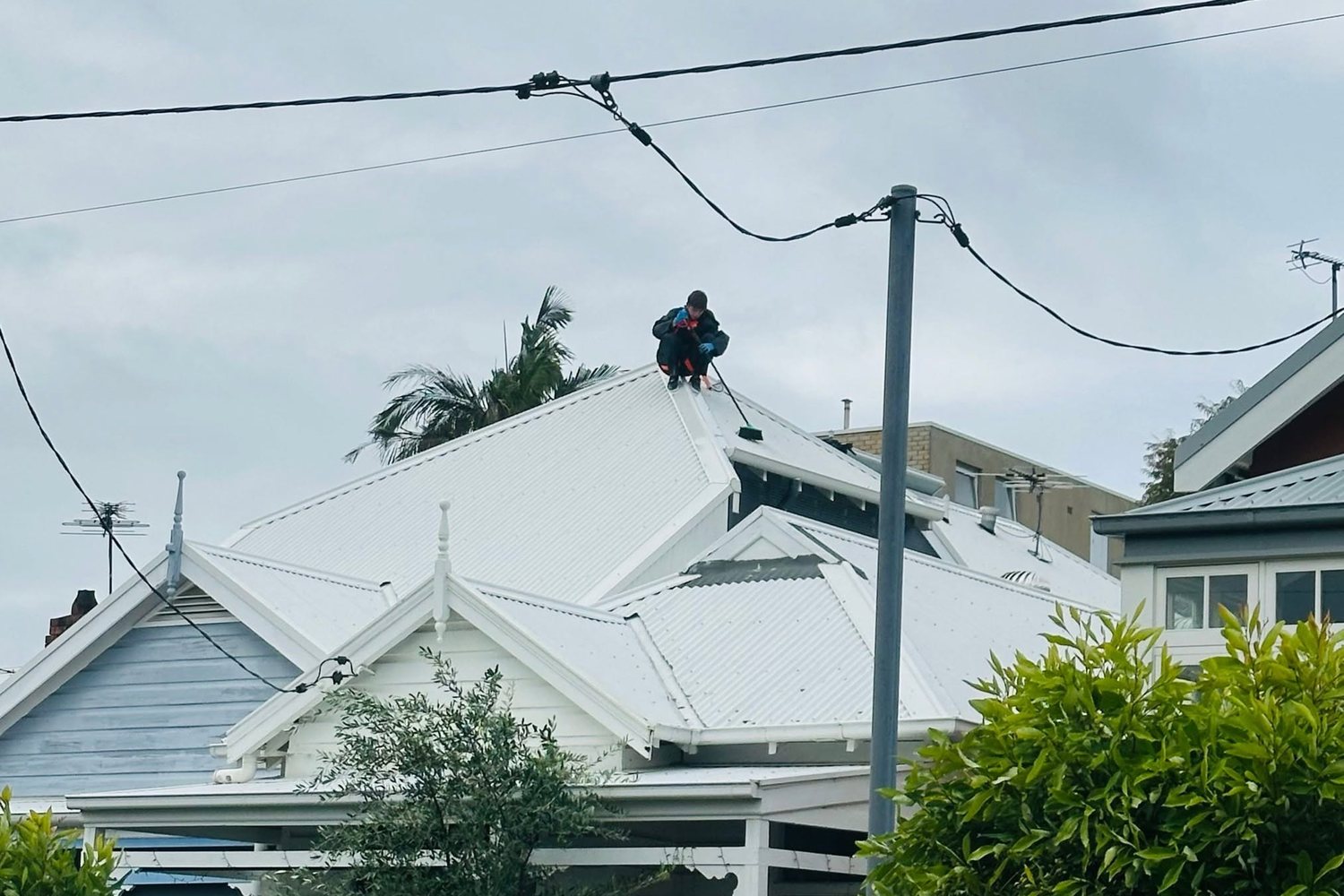
Exposure varies more across Dee Why than across a flat coastal suburb, because the land climbs sharply from the beach to the headland and back toward Cromer. A roof up on that rise catches the full onshore wind, and wind-driven salt spray reaches surfaces that would stay clear at street level closer to the water.
The building stock splits the work. The 1960s and 1970s walk-up blocks that dominate the flat near the beach carry low-pitch or near-flat roofs, often metal deck. Low pitch means water drains slowly, so salt and grit sit in the pans rather than washing off, and corrosion starts around fixings and laps. Those roofs also carry plant, aerials and now solar, all of which trap debris.
The detached homes behind are mostly post-war brick with concrete tile. There the problem is more familiar: porous tile, algae on the shaded pitches, and salt holding moisture in place so growth persists through the drier months.
We treat the two differently, using low pressure and a thorough fresh-water rinse to carry the salt off rather than a scour, and we take particular care around fixings and flashings on metal deck.
For a Dee Why owners corporation, roof cleaning is a deferred-maintenance question rather than a cosmetic one.
Low-pitch metal deck roofs on the walk-up blocks are the concern. Salt and grit that sit in the pans rather than washing off will eventually take the coating, and once corrosion starts around fixings and laps it spreads along the sheet. Replacing roof sheeting across a whole block is the kind of expense that arrives as a special levy, and it is almost always preceded by several years in which cleaning would have been the cheaper intervention.
There is a water ingress angle too. A roof carrying built-up debris feeds it straight into box gutters and outlets, and on a flat-roofed block that path ends inside a top-floor unit rather than over an edge. The insurance conversation that follows is rarely simple.
For freestanding owners the case is more familiar: tile degradation, ridge pointing, and the kerb appeal that matters in a suburb where a lot of stock turns over.
In both cases the clean doubles as an inspection, so failing flashings and lifted sheets get reported while they are still small.
How we clean tile, terracotta and metal roofs across Sydney, what the process involves and what it costs.
Proudly serving Sydney with expert exterior cleaning.
MONDAY: 7:30 AM — 6:00 PM
TUESDAY: 7:30 AM — 6:00 PM
WEDNESDAY: 7:30 AM — 6:00 PM
THURSDAY: 7:30 AM — 6:00 PM
FRIDAY: 7:30 AM — 6:00 PM
SATURDAY: CLOSED
SUNDAY: CLOSED