Where a Willoughby house sits on the plateau changes what grows on its roof. Council describes the central ridges as gently undulating with no rock outcrops. Toward Flat Rock Gully the ground falls away in steep sandstone slopes and scarps, and a roof below a rock face or beside bushland can stay shaded and damp for much of the day. Roof cleaning here starts with an inspection for that reason, because the same suburb holds both kinds of roof.
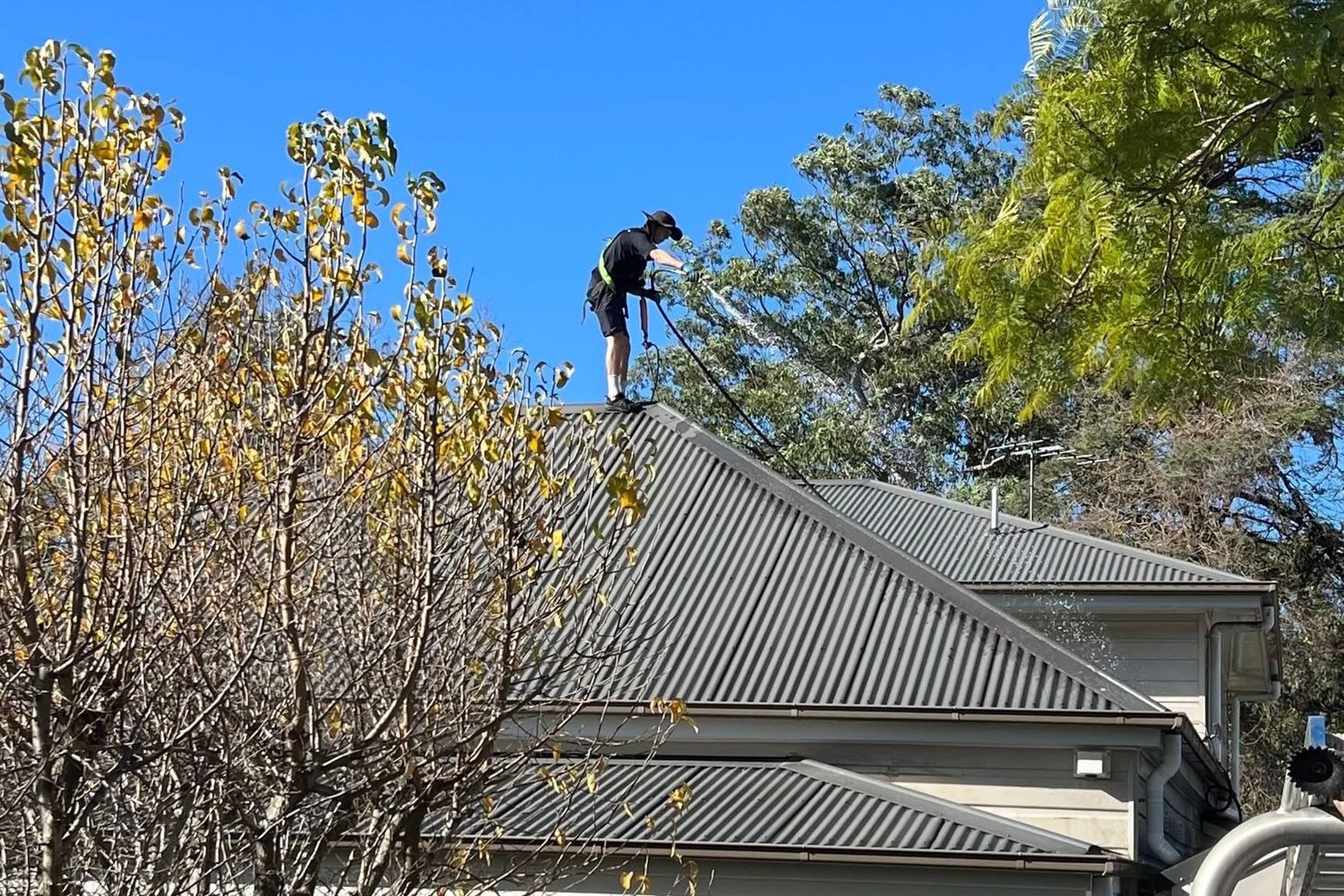
Willoughby sits about 97 metres above sea level on the central plateau of its local government area, and its ridge-top streets are on clay-loam soils that once carried Blue Gum High Forest. That forest was cleared in the 19th century for timber, small farms and orchards, then for housing, and the streets of the south-central precinct now carry planted street trees rather than remnant bush. Those plantings mix exotic and native species, with Brush Box, jacaranda and camphor laurel among them, so a plateau roof may sit under almost any of them.
The southern and south-eastern edge is different ground. Council's street tree plan describes moderate to very steep Hawkesbury sandstone slopes there, with outcrops, benches and broken scarps up to 10 metres high, dropping toward around 14 hectares of remnant bushland in Flat Rock Gully. A house beneath a scarp or backing onto the gully can lose much of its direct sun, and the shaded roof planes are the ones that tend to turn green and black with lichen and moss.
The climate keeps growth going year round, with humidity changing little between months and annual rainfall above 1,200 millimetres. Terracotta, concrete tile and metal each need their own approach; even the 1930s Walter Burley Griffin Incinerator on Small Street is roofed in green concrete tiles. After the inspection we choose between a soft wash and controlled pressure cleaning to suit the surface, then apply an anti-mould and lichen treatment to slow regrowth.
Willoughby City has twelve Heritage Conservation Areas, among them the Willoughby Park area around Fourth Avenue, McClelland Street and Warrane Road, whose key period runs from 1907 to 1930. Council's guidance is that maintenance and repairs introducing no new materials, such as replacing roof tiles with matching tiles, do not need a development application. Switching to a different roofing material falls outside that description.
That makes cleaning the practical way to keep an older roof in service. Lichen roots into the surface of aged terracotta and holds moisture against it, while moss packed along the tile laps slows the water that should be running to the gutter. Removing both, then treating the tiles to slow regrowth, helps the roof you already have stay in service, with any repairs kept to matching tiles.
Outside the conservation areas the case is simpler. A clean roof changes how a house reads from the street and in sale photography, and because an inspection comes first, cracked or slipped tiles can be pointed out while they are still a small fix.
You receive before-and-after photos of the roof, so the result can be seen without anyone in the household climbing a ladder.
Generally, yes. Willoughby City Council treats maintenance that introduces no new materials differently from alterations, and cleaning existing tiles adds nothing new to the roof. If your home is individually heritage listed, or you are unsure what applies to it, check with council before work starts, since individually listed items may carry their own conditions.
In Sydney the south-facing roof planes get the least direct sun, so they stay damp longest after rain. On the slopes falling toward Flat Rock Gully, a sandstone scarp or bushland behind the house can add even more shade. Lichen and moss establish wherever tiles stay wet, which is why one side often looks years older than the other.
Not as a default. The roof is inspected first, and the method is chosen from what that shows: a soft wash, where a cleaning solution applied at low pressure does the work, or controlled pressure on surfaces that can tolerate it. Once the roof is clean, an anti-mould and lichen treatment is applied to slow regrowth.
Yes. Corrugated and Colorbond roofs are cleaned as well as concrete and terracotta tile. A metal carport or rear addition gathers the same mould film and leaf staining as a tiled main roof, so it is worth including when the main roof is cleaned. The approach is chosen with the coating in mind, so the finish is cleaned rather than scrubbed back.
How we clean tile, terracotta and metal roofs across Sydney, what the process involves and what it costs.
Proudly serving Sydney with expert exterior cleaning.
MONDAY: 7:30 AM — 6:00 PM
TUESDAY: 7:30 AM — 6:00 PM
WEDNESDAY: 7:30 AM — 6:00 PM
THURSDAY: 7:30 AM — 6:00 PM
FRIDAY: 7:30 AM — 6:00 PM
SATURDAY: CLOSED
SUNDAY: CLOSED