Concord roofs are low-pitched and the street trees are large, which is an awkward combination for solar. Broad deciduous leaf lands on a shallow array and stays there rather than sliding off, holding moisture against the glass and leaving a tannin stain as it breaks down.
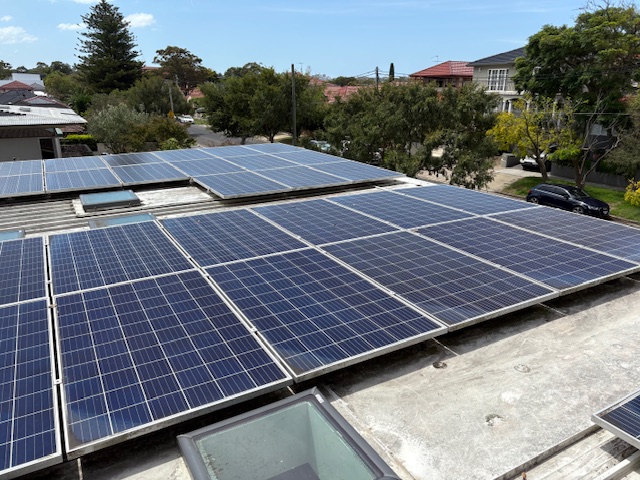
The interaction between Concord's roofs and its trees is what shapes solar maintenance here.
California bungalows and interwar homes have low-pitched roofs by design, with wide eaves and shallow gables. An array mounted on that pitch gets very little help from rain runoff, so anything that lands on it tends to stay put. The plane, brush box and jacaranda planting through these streets then drops a broad, flat leaf across it in autumn, plus flower and seed at other times of year.
Wet leaf sitting on glass leaches tannin, which dries as a brown film bonded to the surface rather than washing off. Because the leaf is large and flat it also shades whole cells outright rather than dimming them, and with cells wired in series that constrains the entire string behind it.
The river adds humidity, so material stays damp on the panel for longer than it would inland, and spring brings a solid pollen load off the same canopy.
We clean with purified water and a soft brush, no detergent and nothing abrasive, and clear the debris that collects along the lower frame of each row as well as the glass itself.
The reason a Concord array underperforms is usually mechanical rather than mysterious: things land on it and nothing takes them off.
On a steeper roof, rain and gravity clear a good deal of light debris. On the shallow pitch typical of a bungalow they do not, so the array holds leaf, seed and pollen through a whole season. Understanding that changes the maintenance interval, and matching the interval to the roof is what recovers the output.
The seasonal pattern gives you a lever. A clean timed after the autumn drop clears the heaviest single load of the year in one visit, rather than leaving it to sit and stain through winter.
Tannin is the part that compounds. Wet leaf left on glass bonds a brown film that becomes progressively harder to remove, so a system left for years needs considerably more work to restore than one cleaned on a sensible schedule.
The debris lodged along the lower frame matters as much as the glass, since trapped organic material holds moisture permanently against the panel seal, which is the part least able to tolerate it.
How we clean arrays with purified water and no detergent, and why output recovers once the glass is clear.
Proudly serving Sydney with expert exterior cleaning.
MONDAY: 7:30 AM — 6:00 PM
TUESDAY: 7:30 AM — 6:00 PM
WEDNESDAY: 7:30 AM — 6:00 PM
THURSDAY: 7:30 AM — 6:00 PM
FRIDAY: 7:30 AM — 6:00 PM
SATURDAY: CLOSED
SUNDAY: CLOSED