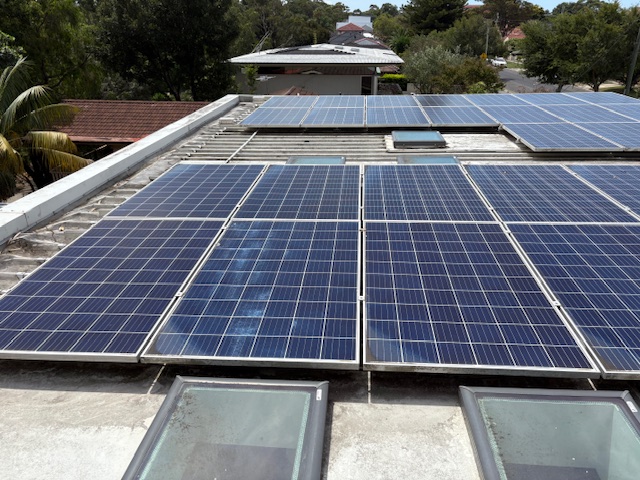
Solar panels in Ashfield sit on everything from terracotta bungalow roofs to strata buildings, and they share the suburb's air with Parramatta Road and the start of the Hume Highway. Dust and soot settle on the glass, street trees add pollen and debris, and birds contribute the rest. Cleaning with purified water and no detergent removes that layer without leaving residue behind, so the panels can take in as much light as possible.
Ashfield is crossed by two major traffic routes. Parramatta Road runs through the suburb, and Liverpool Road leaves it as the start of the Hume Highway, numbered A22. Panels on homes near those roads sit in vehicle exhaust day after day, and soot is one of the deposits that purified-water cleaning is meant to remove.
Trees play a part as well. Brush box lines several of the older streets and is evergreen, so it sheds a little all year rather than in one season, and it flowers over much of the year too. Its small capsules and leaves can lodge along the lower edge of a panel frame, where water runs off the glass, and hold dirt there.
Roofing on heritage homes needs some thought. Council's conservation area statements record original slate and unglazed terracotta across much of the older housing, and those are roofs to treat with care when getting to an array. Team members are certified to work safely at heights, and access is planned around the roof type.
Strata is the other side of Ashfield. With flats making up around seven in ten dwellings, some arrays serve a shared building and sit on a roof residents never see, which makes them easy to overlook until someone checks the output.
Panels can only convert the light that reaches the cells. A coat of dust, soot or pollen cuts into that, and bird droppings are worse because they block light entirely over one patch. Clearing the glass gives the system a fair chance of producing what it was designed to.
The method matters as much as the outcome. Purified water carries no dissolved minerals, so it dries without spots, and because no detergent is used the glass and its coatings are protected.
For owners who keep an eye on their inverter or app, a clean array also makes the output figures easier to trust. If generation is still lower than expected after the panels are clean, the cause is more likely to lie elsewhere in the system, which is useful to know before calling an installer.
Before-and-after photos show the change, which helps strata committees reporting to owners and landlords keeping records on a leased property. With just over half of Ashfield's residents renting, that paper trail can be what an owner living elsewhere relies on.
Because nothing harsh is used, the run-off is no concern for gardens, pets or children below.
Rain helps with loose dust, but it does not reliably shift bird droppings or the film that traffic soot can leave on glass. Homes near Parramatta Road and Liverpool Road sit beside heavy traffic, so panels there may carry more than a shower can clear. Purified water cleaning lifts what the rain leaves behind.
No. Solar panels are cleaned with purified water only. With no detergent there is no residue on the glass, and the purified water dries spot-free, which protects the glass and its coatings. The approach is the same whether the array sits on a single bungalow or across the roof of a strata building.
Tell us the roofing type when you ask for a quote. Many older Ashfield houses have slate or unglazed terracotta roofs, which council lists as original features in several conservation areas, so access is planned with that in mind. The team is certified for safe work at heights and the business is fully insured.
Yes. Strata and commercial buildings are covered as well as houses. Arrays on shared roofs can go unchecked for long stretches because no single owner sees them, and the before-and-after photos give the strata committee a clear record of the clean for its maintenance files.
How we clean arrays with purified water and no detergent, and why output recovers once the glass is clear.
Proudly serving Sydney with expert exterior cleaning.
MONDAY: 7:30 AM — 6:00 PM
TUESDAY: 7:30 AM — 6:00 PM
WEDNESDAY: 7:30 AM — 6:00 PM
THURSDAY: 7:30 AM — 6:00 PM
FRIDAY: 7:30 AM — 6:00 PM
SATURDAY: CLOSED
SUNDAY: CLOSED