Solar on a Newtown terrace has to fit around heritage rules as well as a small roof. Inner West Council treats panels as exempt development in most cases if they cannot be seen from the street, and the City of Sydney has its own guideline for its heritage conservation areas, which can push arrays onto rear roof planes and back wings. Those spots are hard to see from anywhere, which makes it easy to forget the panels need cleaning at all.
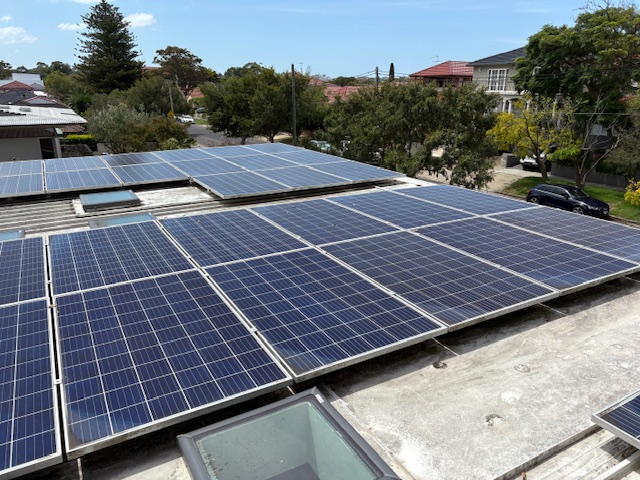
A terrace about 4 metres wide has very little roof to give to solar, and on a heritage street much of what it has faces the front. That leaves the rear roof plane or the roof over the back wing, where panels can sit out of sight. Out of sight also means out of mind: owners rarely see the glass, and the first sign of a dirty array is often a dip in output.
What settles on those panels depends on where you are. Homes close to King Street, which carries Princes Highway traffic through the suburb, sit beside a steady source of exhaust soot and fine road grime that dries onto glass as a dull film. Near Camperdown Memorial Rest Park, Salmon Park or Enmore Park, the large figs and other mature trees add leaf fragments and pollen, and droppings can land on any array regardless of location. Unlike a thin film of dust, a dropping is opaque and blocks the light to the cells beneath it.
Strata buildings, including the walk-up flats and tower blocks built from the late 1960s onwards, may carry arrays on flat or low-pitched roofs, where dust has less chance of rinsing off in rain.
Cleaning uses purified water with no detergent, which dries spot-free and is gentle on the glass and its coatings.
On a big suburban roof, a little lost output is spread across a large array. On a Newtown terrace, where heritage rules and a narrow roof may restrict a system to a handful of panels on the rear plane, each panel carries more of the household's load, so a grime film or a cluster of droppings matters more.
Washing with purified water instead of detergent means nothing is left behind on the glass. Purified water dries without spots and protects the coatings applied to panel glass, so the clean itself does not create a new layer for dust to cling to.
Because the arrays are tucked away, before-and-after photos are often the only clear view an owner gets of their own panels. They show how much soot, pollen and fouling had built up and what the glass looks like afterwards, which is useful when comparing generation figures before and after a clean.
For strata committees and landlords, those photos also serve as a record. With almost 40 percent of Newtown's occupied homes being flats or apartments at the 2021 Census, plenty of arrays here belong to an owners corporation rather than a single household, and a documented clean is easy to report back on.
On a terrace the array is often hidden on the rear plane, so the first clue is usually your inverter or app showing lower generation than you would expect for the weather. Before-and-after photos taken with each clean give you a look at the panels themselves, which is otherwise hard on a narrow Newtown block.
King Street carries Princes Highway traffic, and exhaust soot and fine road grime settle on nearby roofs along with ordinary dust. Over time that forms a dull film that rain does not always shift. Purified water removes it without detergent and dries spot-free, so the glass is left clear rather than coated.
Yes. Solar panel cleaning is carried out on strata and commercial buildings as well as houses. Have the strata manager or committee contact us for a quote, and mention the roof type and how it is accessed. Before-and-after photos give the owners corporation a record of the work.
Ordinary tap water can leave mineral spots as it dries, and climbing onto a terrace roof to reach a rear array is risky. The cleaning uses purified water with no detergent, which dries spot-free, and team members are certified to work safely at heights.
How we clean arrays with purified water and no detergent, and why output recovers once the glass is clear.
Proudly serving Sydney with expert exterior cleaning.
MONDAY: 7:30 AM — 6:00 PM
TUESDAY: 7:30 AM — 6:00 PM
WEDNESDAY: 7:30 AM — 6:00 PM
THURSDAY: 7:30 AM — 6:00 PM
FRIDAY: 7:30 AM — 6:00 PM
SATURDAY: CLOSED
SUNDAY: CLOSED