Newtown's terrace rows were built tight, and their roofs show it. Two-up two-down terraces about 4 metres wide sit shoulder to shoulder, many with party walls carried up above the roofline, so each house drains a small patch of roof through a short gutter run to its outlet. Anything that lands there has nowhere else to go. Gutter cleaning in Newtown is less about sheer volume of leaf and more about keeping those short, crowded runs flowing.
Most of Newtown's street trees are small. Council's heritage statements for the Enmore-Newtown and Holmwood Estate areas describe low-growing natives, mainly Melaleuca with some bottlebrush, planted close to the facades so they screen the houses rather than shade the street. Their narrow leaves slip easily into a gutter and settle into a fine layer that packs down around an outlet instead of sitting loose on top.
The big trees are concentrated in a handful of places. The walled cemetery beside St Stephen's on Church Street and the adjoining Camperdown Memorial Rest Park hold a Moreton Bay fig planted in 1848 with a spread of more than 30 metres, English oaks of the same age and a large stand of brush box. Salmon Park off Salmon Street has several mature figs, and Enmore Park has figs of its own. Homes beside any of these can carry a heavier and more varied load, with oak leaf arriving in autumn on top of evergreen litter.
The building form matters as much as the trees. On the parapet-fronted Boom Style terraces around Hollis Park the front gutter line is hidden from the street, so a blockage can go unnoticed. Further south, some early workers' terraces in Simmons Street sit under a single hipped roof with no firewalls between houses, which makes the roof edge a shared concern for the whole row.
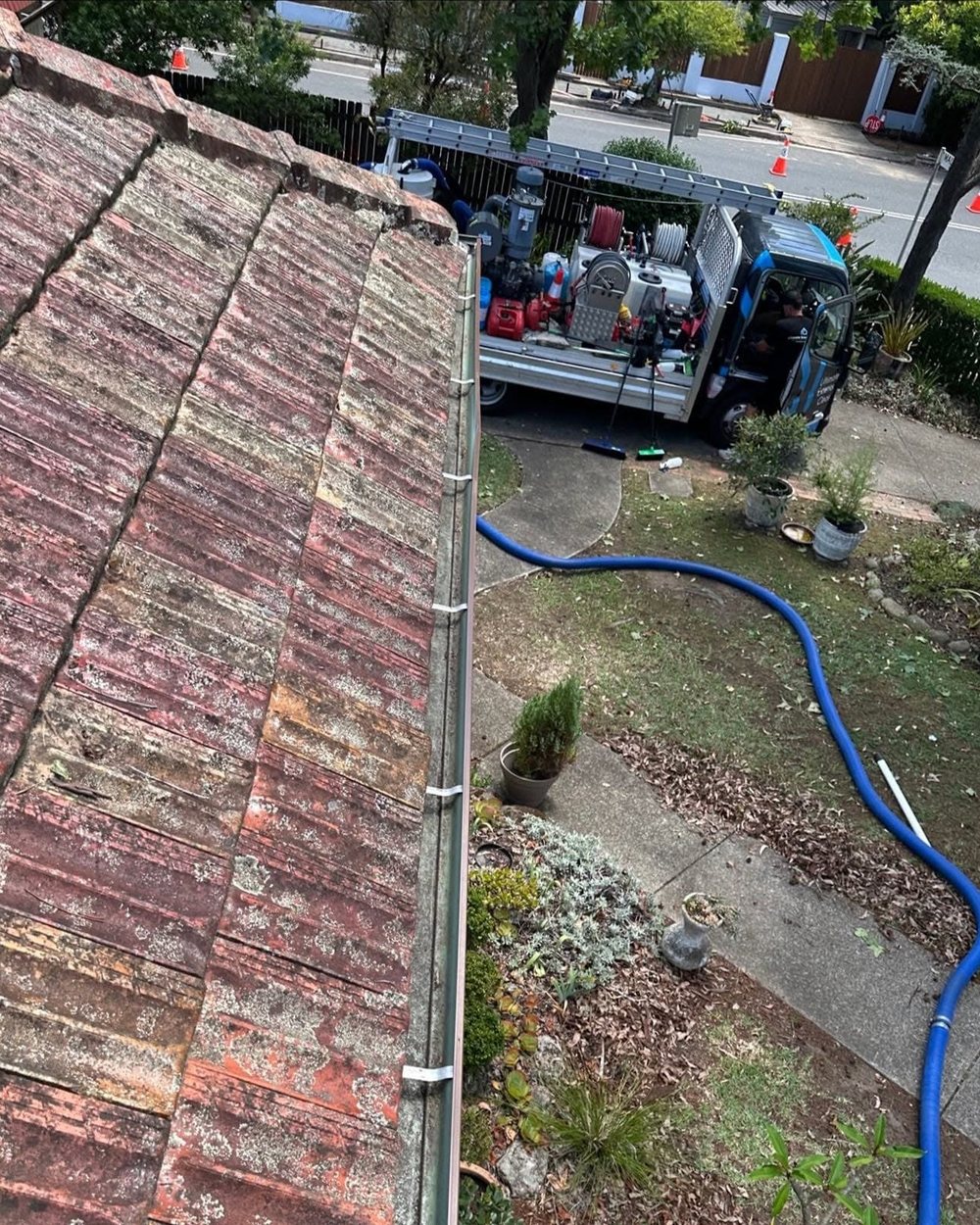
With narrow streets and front walls close to the footpath, there is little room for ladders. High-reach gutter vacuums are worked from the ground, and box gutters, valleys, outlets and downpipes are all checked.
With so little roof per house, a Newtown terrace has almost no margin for error. Once its one outlet chokes, a short gutter fills fast and the water finds its own way out: over the front edge onto the step and footpath, or back towards the party wall and into the ceiling space.
The walls it runs down are the ones council's heritage statements ask owners to look after. Unpainted face brick, including the two-tone duochrome brickwork on many Federation terraces in Holmwood and Dickson Streets, is valued precisely because it has never been rendered or painted. Repeated overflow streaks and stains that brick, and painting over the damage is exactly the kind of change council lists as detracting from a heritage streetscape.
Every gutter clean includes a roof inspection report and before-and-after photos. More than half of Newtown's occupied homes are rented, according to the 2021 Census, and for landlords and managing agents who seldom see the roof themselves, that report is a practical maintenance record. For owner-occupiers it is a look at a roof that is hard to see from a narrow street.
Vacuuming keeps the material out of the downpipes rather than flushing it through to the stormwater. If you would rather not keep the collected leaf, rubbish and green waste removal is available as a paid add-on.
Melaleuca and bottlebrush leaves are narrow and light, so they blow onto roofs easily and slide down into the gutter. Mixed with dust and grit they settle into a dense layer around the outlet. On a short terrace gutter feeding a single downpipe, that is enough to stop the flow even without a big tree overhead.
It can. The park and the cemetery beside St Stephen's hold a very large Moreton Bay fig, old English oaks and many brush box, so nearby roofs catch more leaf than most Newtown streets. Oak leaf comes down in autumn, so planning a clean after the drop makes sense for homes close by.
Box gutters, internal valleys, outlets and downpipes are all checked as part of the clean, not only the gutters you can see. A parapet hides the front gutter line from the street, which is why the roof inspection report and before-and-after photos are useful: they show parts of the roof you cannot see from the footpath.
The high-reach vacuums are worked from the ground, so there is no need to stand a long ladder in a tight lane or on a narrow front path. Mention any rear lane access when you ask for a quote, because where a row backs onto a lane the rear gutters may be easier to reach from there.
How vacuum gutter clearing works, what we check while we are there, and what it costs across Sydney.
Proudly serving Sydney with expert exterior cleaning.
MONDAY: 7:30 AM — 6:00 PM
TUESDAY: 7:30 AM — 6:00 PM
WEDNESDAY: 7:30 AM — 6:00 PM
THURSDAY: 7:30 AM — 6:00 PM
FRIDAY: 7:30 AM — 6:00 PM
SATURDAY: CLOSED
SUNDAY: CLOSED