Coogee arrays get excellent light and pay for it. Salt comes off the bay continuously, gulls treat these rooftops as a perch, and a great many of the systems here sit on low-pitch strata roofs where rain does almost nothing to help.
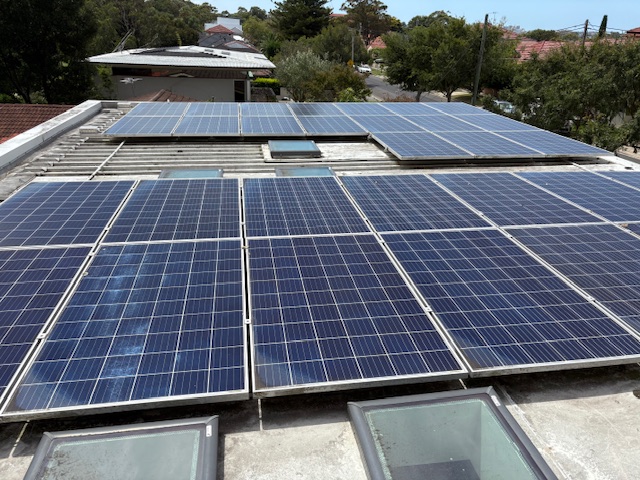
An array in Coogee is working in one of the harder environments in Sydney, and the roof it sits on usually makes it worse.
Salt is the constant. Because it is hygroscopic it stays faintly damp rather than drying to a dust that blows away, and it binds windblown sand and dust into a film bonded to the glass. Rain rinses the loose material and leaves the bonded layer behind, and because it builds evenly across the whole array there is no dirty patch to prompt a clean. Output simply drifts downward.
Gulls are the sharper problem. The bay supports a substantial population and rooftops here are perches. A dropping is opaque rather than translucent, so it blocks a cell rather than dimming it, and because cells run in series within a panel one blocked cell throttles the current for its entire string. A few small marks cost far more than their area suggests.
The low-pitch roofs on the walk-up blocks are the third factor. Shallow pitch means very little runoff assistance, so whatever lands tends to stay, and arrays on those roofs sit alongside plant and aerials that shed their own debris.
We clean with purified water and a soft brush, no detergent, from ladders and height-safety gear rather than by walking the array.
Solar is one of the few exterior services where the result is measurable, and in this position it is usually worth measuring.
The salt film is the loss nobody sees, because it builds uniformly and produces no visual trigger at all. Owners here routinely discover they have been running well below capacity for years, having assumed the system had simply aged. On a system bought against a stated payback period, every month below rated output extends that period, and for anyone exporting it is straightforward lost income.
The gull fouling is the loss that costs most relative to its size, because a handful of opaque marks can throttle whole strings rather than costing a proportional share of surface.
Left long enough, droppings bake onto the glass in summer sun and become acidic enough to etch it, which turns a maintenance issue into a hardware one that no cleaning reverses.
Cleaning with purified water and no detergent matters more here than inland, because any detergent residue gives salt something to key into and brings the film back faster.
For strata buildings with a shared system, that lost generation is a cost carried by every lot owner.
How we clean arrays with purified water and no detergent, and why output recovers once the glass is clear.
Proudly serving Sydney with expert exterior cleaning.
MONDAY: 7:30 AM — 6:00 PM
TUESDAY: 7:30 AM — 6:00 PM
WEDNESDAY: 7:30 AM — 6:00 PM
THURSDAY: 7:30 AM — 6:00 PM
FRIDAY: 7:30 AM — 6:00 PM
SATURDAY: CLOSED
SUNDAY: CLOSED